God Finishes What He Starts: Finding Hope in the Unfinished Seasons

Have you ever driven past a half-built bridge that seems to have been sitting there for years? Or noticed houses in your neighborhood with construction that appears stalled—materials sitting idle, projects seemingly abandoned? There’s something unsettling about unfinished things. They leave us wondering: Will this ever be completed? Has someone given up?

Perhaps your life feels like one of those unfinished projects right now.

The Weight of Unfinished Business

As we stand on the threshold of a new year, many of us carry the weight of incomplete dreams, stalled plans, and unanswered prayers. We look back at the year behind us and wonder why certain doors never opened, why some relationships never healed, why that calling we felt so certain about seems to have gone nowhere.

The silence can be deafening. The waiting can feel endless. And in those quiet moments, doubt creeps in with its persistent questions: Did I miss God’s plan? Did I make too many wrong choices? Has He given up on me?

A Promise Written From Prison

The Apostle Paul understood something profound about God’s faithfulness, and he wrote about it from the most unlikely place—a prison cell. Imagine being locked away, your ministry seemingly halted, your freedom stripped away. Yet from that dark place, Paul penned these powerful words in Philippians 1:6:

“I am sure of this, that he who started a good work in you will carry it on to completion.”

Read that again slowly. Paul wasn’t writing from a comfortable couch after a successful ministry tour. He was writing from chains, from confinement, from what appeared to be a complete derailment of God’s purposes. Yet his confidence wasn’t shaken. Why? Because his confidence wasn’t in his circumstances—it was in God.

You Are the Good Work

Here’s a truth that might change your perspective today: You are the good work God started.

Not your job. Not your ministry. Not your family situation or your bank account or your reputation. You. You are the masterpiece in progress, the clay on the potter’s wheel, the project God is committed to completing.

And here’s the remarkable thing about God as a craftsman: He knew exactly what He was getting into when He started working on you. He wasn’t surprised by your mistakes. He didn’t say “oops” when you took that wrong turn. He didn’t have to adjust His plans when you spent years wandering in the wilderness of addiction, rebellion, or doubt.

God has never once said, “I didn’t see that coming.”

The Potter’s Persistent Hands

In Bethlehem, there’s a village where potters still work the ancient way—spinning wheels, wet clay, skilled hands shaping vessels. A master potter was once observed creating a beautiful vase when suddenly one side began to droop. Without hesitation, he pressed the entire piece back down into a ball and started over.

But notice—he didn’t throw the clay away. He didn’t abandon the project. He simply reshaped it, remolded it, and began again.

The Bible calls us clay in the Potter’s hands. Maybe what feels like crushing pressure right now is actually God reshaping you. Perhaps that disappointment, that closed door, that painful season wasn’t the end of His plan—it was part of the process of forming you into something even more beautiful than you imagined.

The Punch List Phase

In construction, there’s a phase called the “punch list”—that period after all the major work is done when crews go through and handle the small details. Touch-up paint. Minor adjustments. Final inspections. It’s not glamorous. It’s not exciting. There are no dramatic transformations happening. But it’s absolutely essential to completing the project.

Maybe you’re in the punch list phase right now.

The big, dramatic movements of God in your life may have quieted down. You’re not seeing the miracles you once saw. The passion that used to burn bright feels like it’s dimmed to embers. But don’t mistake the quiet for abandonment. God is still working. He’s just working on the details now—the character refinements, the subtle shifts, the internal transformations that don’t make for exciting stories but are crucial for what comes next.

Pruning Isn’t Punishment

Rose bushes that are left unpruned become wild, overgrown, and eventually stop producing beautiful blooms. A wise gardener takes shears and cuts back the branches—sometimes drastically. To the untrained eye, it looks like destruction. But the gardener knows that in a few months, the bush will return fuller, healthier, and more beautiful than before.

Sometimes God prunes us. He cuts away things we thought were essential. He removes people, opportunities, or comforts we believed we needed. And it hurts. Pruning always does. But it’s not punishment—it’s preparation. He’s making room for new growth, healthier patterns, and more abundant fruit.

When the Delay Isn’t a Disconnect

We live in an instant culture. We expect immediate responses to our texts, same-day delivery on our purchases, and quick answers to our prayers. So when God seems silent, we assume He’s disconnected. When He doesn’t move on our timeline, we conclude He’s not moving at all.

But sometimes the delay is part of the design.

Behind the scenes, God is working out details you can’t see. He’s arranging circumstances, preparing people, and orchestrating events that will all come together at exactly the right moment. The fact that you can’t see the progress doesn’t mean there isn’t any. It just means you’re not the foreman on this project—He is.

The Partnership Principle

God chose to work in partnership with us, not as a dictator barking orders. He invites us into relationship, gives us choices, and allows us to participate in His purposes. But here’s the beautiful part: even when we mess up our side of the partnership, He doesn’t void the contract.

He established a covenant, not a contract. A contract says, “I’ll do my part if you do yours.” A covenant says, “I’m committed regardless of what you do.” That’s the kind of God we serve—one who remains faithful even when we’re faithless, who keeps His promises even when we break ours.

Confidence for the Coming Year

As a new year begins with all its uncertainty, where will you place your confidence? In your job security? Your health? Your relationships? Your own ability to figure things out?

Or will you place it where Paul did—in the God who finishes what He starts?

The same God who kept His promise to bring Israel back to their land after centuries of exile is the same God who’s keeping His promises to you. The same God who transformed a murderous Saul into the Apostle Paul can transform your mess into a message. The same God who raised Jesus from the dead can resurrect the dead dreams in your life.

Your story isn’t over. The project isn’t abandoned. The bridge will be completed. The house will be finished.

Because the One who began the good work in you is faithful to complete it—not when you deserve it, not when you’ve earned it, but because that’s who He is.

You are a good work. And God always finishes what He starts.

Living Above Reproach: Does Jesus Know Who You Are? This Christmas

Christmas is quickly approaching and you can feel it. The wrapping paper, the lights, the shopping, the family, and the gifts. Christmas is a time of family traditions, celebrating with loved ones, and of course, giving and receiving gifts. But amid all of the commercialism, familial festivities, and culture lies a much deeper question and issue that should terrify us and move us to repentance. The question is this: Does Jesus know who you are?

Note that the question is not “Do you know who Jesus is?” We all think we do. Just as the multitudes knew who Jesus Christ was, most of them could also rattle off the name of the president or other public figures without hesitation. We could do the same thing. The question, though, is this: Does Jesus know who you are? Has He written your name in the Lamb’s Book of Life? Do you know Him, and is He known by you, as His child, His joint heir?

Jesus’ Rebuke of Religious Hypocrisy

Jesus would have had no problem knowing exactly who you are if you were one of the men in Matthew 23. You may remember that in this passage, Jesus had a bone to pick with the scribes and Pharisees. They sat “in Moses’ seat” meaning they had taken positions of authority among the people. Jesus said to them “you have authority, and it will not be taken from you.” (Matt. 23: 2) They were the religious and spiritual leaders of the day. The people loved them, respected them, and followed them. The common people were told to listen to what they taught but not to follow their example because they did not practice what they taught.

“Don’t do what they do because they do not practice what they preach.” Authority without integrity is nothing.

These men would impose huge demands on people but never offer to help lift a burden. They required people to follow 613 laws which were man-made requirements placed around God’s original Ten Commandments. They were more interested in relationship turned to religion than in relationship based on grace.

How often do we do this very same thing in our own lives? We tell our families to forgive but never really forgive in our own lives. We may talk about loving our enemies but secretly plot and plan evil against those who have done us wrong. We claim to follow Christ but our daily lives show a complete lack of His transforming power.

The Sin of Performance Faith

The saddest part of the story, however, is that the Pharisees did all that they did “to be seen by others.” It’s one thing to wear phylacteries or lengthen your tassels or love the place of greatest honor. (Matt. 23: 5) It’s even another to be known as “Rabbi.” It’s tragic to crave titles and applause from crowds of people. But when that’s what we live for, when that’s what we do life becomes a performance of faith rather than the reality of relationship.

Is that not the temptation and trap of our day in this age of social media? We can do every deed of service and post it online. We can give and hashtag it with a big photo to boot. We can feed the hungry and take a selfie of us doing it. We can serve others, make them feel important, and then post it on Facebook to show how important we are for doing it.

But the kind of faith that Jesus commends is different. It serves and never needs applause. It gives and never requires recognition. It loves and does not demand acknowledgment.

The couple who for twenty years never missed a Tuesday night tradition at a local Pizza Hut but someone paid for their meal one night without their knowledge is a great example of this. They went to eat their pizza that week and received the anonymous gift of love and kindness but when the people who gave the gift left before they could thank the Pizza Hut customers, weeks later a note came. “We just wanted to thank you for loving people the way Jesus does.”

Rules Before Relationship = Rebellion

Another very hurtful sin which is so common in many religious people and places is the requirement of a list of rules before relationship. We often tell people they must stop drinking or smoking or cussing or drinking coffee or eating sugar or listening to rock music or not wearing long skirts or pants before they can have a relationship with Jesus. It’s a brutal system of us versus them, good versus evil, right versus wrong, black versus white, with no room for gray or grace.

But Jesus never did it this way. He always placed relationship above rules. He always reached out to people in love and then asked them to follow Him in life transformation. But the moment we place rules before relationship is the moment we create more rebels than saints.

Ask yourself and your family about your church and your own faith life. Do they feel like they must measure up to some impossible list of rules and regulations in order to have a relationship with God? Ask your family if they were being interviewed, how would they describe your faith? Is it a burden of legalism or an invitation to a loving relationship?

Servant Leadership

Jesus makes another remarkable statement about leadership in Matthew 23. “The greatest among you will be your servant.” Jesus turns the world’s idea of leadership on its head by stating, “Whoever exalts himself will be humbled, and whoever humbles himself will be exalted.” This is why servant leadership is such a vital concept in ministry.

Servant leaders do not stand in the front and tell everyone else to do what they say. They work from behind and lift everyone else up so that everyone gets served and the least receive the most.

This is why James and John’s mother’s request for her sons to be on Jesus’ right and left hand in His kingdom was so fascinating. She misunderstood the operation of God’s kingdom. The first will be last and the last will be first in God’s kingdom. Greatness will be measured by servanthood, not status.

Living Above Reproach

My father had a simple principle of never being alone in his office with someone of the opposite sex unless they were your wife or your daughter. This is not because he did not trust others or thought they would sin if alone with someone of the opposite sex. This was not because he was full of fear or distrust. This was simply to ensure that he lived his life above reproach. No one could ever look at his life and question his integrity or twist his actions in any way.

I have often said that we live in a world of whispers and a generation of selfies, and that is so true. With the rise of social media, with the freedom of anonymity on the internet, and with the staggering number of people who record other people’s conversations and actions, we must live in such a way that our life is above reproach.

This does not mean that we cannot ever do anything wrong. It does not mean that we live a life of perfectionism. It does mean that our life matches our words. It means that people could read what we say about Jesus and look at our lives and see no great chasm between our words and our deeds.

Does Jesus Know Who You Are?

You have four days until Christmas. The real test is not about whether you will be giving gifts or whether you will be receiving gifts. The real question is this: Will you give away the gift of salvation to a person this Christmas who needs it?

This is not easy or simple or a matter of one or two sentences. This is a matter of daily prayer, asking God to open the hearts of people, to allow the Holy Spirit to move on them, to send divine appointments your way, and to give you the opportunity and the courage to speak life and truth into the lives of family members and friends who have no idea of the urgency and depth of Jesus’ love for them.

For if we will not tell someone the truth, how much do we really love them? For if we will not lovingly challenge people and make them feel uncomfortable for their own good, how much do we love them? And if love without truth is not really love at all, let’s have a Merry Christmas.

Jesus Plus Nothing Equals Everything

Have you ever stopped to consider where you were five years ago? What about one year ago, or even six months ago? Sometimes it’s good to pause and remember the journey—to reflect on how far God has brought us and what He’s rescued us from.

The Christian life is a fascinating journey. We start with faith in Jesus Christ, saved by grace, rescued from the pit. But somewhere along the way, many believers begin to feel like something’s missing. A nagging thought creeps in: Maybe I’m not doing enough. Maybe I need to add something to my salvation.

This is where things get dangerous.

The Galatian Problem

The early church faced this exact issue. In the book of Galatians, the Apostle Paul addresses believers who had started their journey with Jesus but were being convinced they needed to add something more—specifically, obedience to the Old Testament law—to complete their salvation.

Paul’s words are sharp: “You foolish Galatians! Who has cast a spell on you?” (Galatians 3:1). He’s not attacking them out of malice; he’s trying to wake them up from a dangerous deception. These were people who loved Jesus but were being told that faith in Christ wasn’t quite enough.

Paul asks them a pointed question: “Did you receive the Spirit by the works of the law or by hearing with faith?” (Galatians 3:2). The answer was obvious—they received salvation through faith, not through keeping religious rules.

Then comes the kicker: “Are you so foolish? After beginning by the Spirit, are you now finishing by the flesh?” (Galatians 3:3).

Starting One Way, Finishing Another

Imagine running a marathon. You start at the starting line, following the marked course with all the other runners. You’re making good progress, you’re on the right path. But then, halfway through, you decide to turn around and run the opposite direction. Or maybe you get on a tricycle for the last lap instead of continuing to run.

Sounds absurd, right? Yet this is exactly what happens when we start our faith journey trusting in Jesus alone, then begin adding our own works, rituals, or religious observances as though Christ wasn’t sufficient.

The law was never meant to save anyone. If it could have saved us, Jesus wouldn’t have needed to come. The Old Testament sacrificial system required a high priest to enter the Holy of Holies once a year on the Day of Atonement—and they tied a rope around him in case he died in there so they could drag his body out. Year after year after year, this ritual was repeated.

Why? Because it didn’t work permanently. It was like putting duct tape on a leaking hose—a temporary fix that would need to be redone again and again.

The Fulfillment

Jesus came to fulfill what the law could never accomplish. When He died on the cross, His final words were, “It is finished.” Not “It is mostly finished, but you’ll need to complete it by keeping the law.” Not “It is finished, but you better make sure you do enough good works to keep it.”

It. Is. Finished.

One sacrifice. One time. For all sin—past, present, and future.

Consider Abraham, the father of the Jewish nation. He lived before the law was given. There were no Ten Commandments yet, no 613 regulations to follow. Yet the Bible says, “Abraham believed God, and it was credited to him as righteousness” (Galatians 3:6).

Faith. That’s how Abraham was saved. That’s how Enoch, who walked with God and was taken up to heaven, was saved. That’s how Joseph, sold into slavery but faithful to God, was saved. Faith has always been the key.

God introduced the law because His people kept misbehaving, but it was never meant to be the path to salvation. It was meant to show us we need a Savior because we cannot possibly keep all those rules perfectly.

The Danger of Adding

There’s a movement today—sometimes called Hebrew Roots or Torah-keeping—that teaches Jesus is the Messiah but that believers must also observe Old Testament law to maintain their salvation. These aren’t necessarily evil people trying to lead others astray. Often, they’re sincere believers who feel they haven’t done enough and are trying to add to what Christ accomplished.

But here’s the problem: the moment we add anything to Jesus, we’ve changed the gospel. And if we’ve changed the gospel, we no longer have the gospel that saves.

Jesus plus nothing equals everything. Jesus plus anything equals a different gospel.

The Sufficient Gift

Picture a man drowning in debt. Credit cards maxed out, loans unpaid, bills piling up. He stops opening his mail because he knows every letter is another demand for payment. Then one day, he opens a letter from the bank: “All your debts have been paid. A benefactor has covered everything. You owe nothing.”

Incredible news, right? But then, week after week, this man keeps writing checks and sending them to the bank, trying to pay back what’s already been paid. The bank keeps returning his checks with the same message: “You don’t have an account with us anymore. Everything’s been paid.”

Why does he keep trying to pay? Because he’s afraid the gift might be taken back. He can’t believe it’s really free.

Many believers live this way with their salvation. They keep trying to “pay” for what Christ already purchased. They can’t accept that grace is truly sufficient.

The Christmas Gift

This Christmas season, remember what we’re really celebrating. Not trees or lights or presents, but the fulfillment of God’s plan from before the foundation of the world. We celebrate that God entered time and space as a baby, lived a perfect life, and died to pay a debt we could never pay.

His grace is sufficient. You don’t need to add to it. You can’t add to it. Trying to add to it actually diminishes what Christ accomplished.

So rest in this truth: if you’ve placed your faith in Jesus Christ, you are saved—completely, fully, eternally. Not because of what you’ve done, but because of what He did.

That’s the gift. And it’s enough.

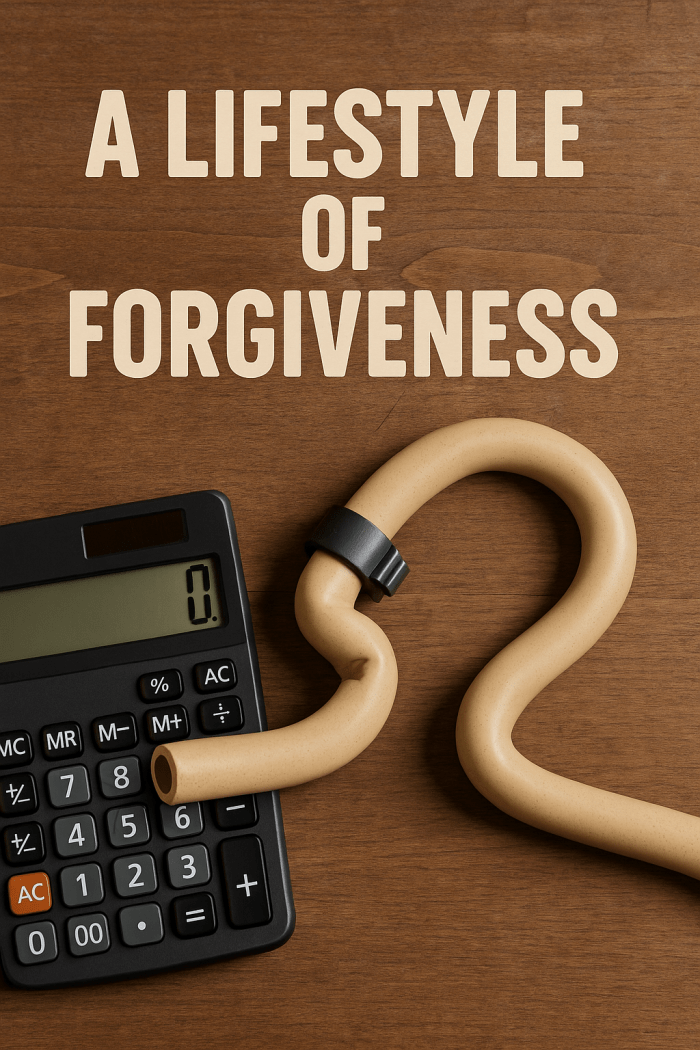
A Lifestyle of Forgiveness

When people think of Christmas, they usually think of family. No matter how far away or how long it’s been since you last saw them, something about this season always seems to bring us back home, back together, back to what’s important.

But what if there is unforgiveness in your life keeping you from those you need to celebrate with?

The Calculator We Need to Throw Away

Peter asked Jesus a question in Matthew 18 that must have sounded incredibly generous coming from him. Religious leaders in his day taught that forgiving someone three times made you righteous—you had done your spiritual homework, so to speak. So Peter, feeling perhaps very magnanimous at the time, inquires of Jesus: “Should I forgive someone seven times?”

Jesus’ answer must have blown him away: “Not seven times, but seventy times seven.”

He was not giving Peter license to whip out a calculator and start keeping track. Jesus was talking about throwing away the very calculator itself! He was saying that forgiveness is not a mathematical equation with a finite answer. It’s a lifestyle.

I love my smartphone. I have the calculator, the notes app, reminders, spreadsheets, everything. But I do not need to track forgiveness, because forgiveness is not about mathematical equations.

The Unpayable Debt

Jesus follows up with a parable that drives this point home. The servant owed his king an unfathomable amount of money—10,000 talents. To give you an idea of how much money this is, think of every penny you could ever possibly earn in this life and multiply it by several lifetimes. This is not $1,000 or $50,000 or even $300,000. This is an incomprehensible, unpayable debt.

The servant falls at the king’s feet and begs for patience. He promises to pay back everything, both of them knowing this to be an impossibility. Yet the king has compassion, sets the servant free, and forgives the entire loan.

This is the picture of our salvation. We owed God a debt that could never be paid. Our sins created a gaping chasm between ourselves and God that no amount of good works, no amount of effort, no amount of time could ever have bridged. And yet, God forgave it all.

The Tragic Irony

But here’s where it gets really tragic. This same servant, newly forgiven of millions, goes out and finds a fellow servant who owes him an insignificant amount—100 denarii. Pocket change in comparison. He grabs this man by the throat, demanding payment. When the fellow servant begs for patience, using the exact same words he had just used before the king, the forgiven servant does not relent. He has the man thrown into prison until he can pay what he owes.

I am amazed by the irony. How does someone in prison earn money to pay a debt? Logically, it is impossible. But this is what we do when we refuse to forgive. We lock people into relational prisons, cut them off from all communication with us, and then somehow expect them to fix what was broken. We make restoration impossible and then demand it.

The Chains We Choose to Wear

Consider this image: A prisoner chained to a wall—chains on his feet, his arms, across his chest, around his throat. A new guard walks by one day and asks the prisoner why he’s still standing there. He responds that he’s chained to the wall. The guard looks at him, shocked, and replies: “We unlocked those chains years ago.”

When God saves us, he sets us free. The chains of sin, guilt, and condemnation are broken. Yet many of us remain in the same spot, not because we’re chained to the wall, but because we’re still wrapped up in the bitterness and unforgiveness we are not willing to let go of. We have been set free but are still standing against that wall, convinced that we’re trapped.

The Cost of Unforgiveness

The parable ends with a sobering warning. When the king hears of what the forgiven servant has done to the other, he has him brought before him, only to have him sent to the jailers to be tortured until he can pay everything he owes. Jesus drives the point home: “So also my heavenly Father will do to you unless every one of you forgives his brother or sister from your heart.”

This is not saying that unforgiveness can change your eternal destination if you’re truly saved. But it does mean that you’re living a lesser life than you could. Unforgiveness gives the enemy legal ground to torment you. It shows up in patterns you can’t break, behaviors you can’t make sense of, and bondage you can’t explain.

When we refuse to forgive, we grieve the Holy Spirit. We are like a garden hose with a kink in it—connected to the water source, but with no flow, no power, no life-giving water reaching its destination.

A Christmas Challenge

Before you get together with family this Christmas, before you open gifts, before you cook that meal or go to that party, ask the Holy Spirit a simple question: “Who do I need to forgive?”

Maybe it’s been five years since you last spoke to them. Maybe twenty. Maybe they’re a family member who will be at the Christmas table. Maybe they’re someone who hurt you so deeply, you can’t imagine ever releasing it.

Forgiveness isn’t about whether they deserve it. You didn’t deserve it either. None of us did. “God proved his love for us in that while we were still sinners, Christ died for us” (Romans 5:8).

The Gift That Keeps Giving

Christmas is the celebration of the ultimate gift—God leaving heaven, coming to earth as a baby in a manger, to live a perfect life, die a criminal’s death, all to save humanity that did not deserve it. Before He even created the world, He knew what we would do and still chose to create us anyway. He chose to love us anyway. He chose to save us anyway.

Grace was never meant to be kept. It was meant to be given away.

Forgiveness is not situational. It’s a lifestyle. It’s a conscious decision we make every day. We choose to love. We choose to extend mercy. We choose to give grace. Not because people have earned it, but because it was freely given to us.

Forgive from your heart this Christmas. Make the call. Send the text. Open the door. Life is too short, and eternity is too long to live in the prison of unforgiveness.

The calculator can be thrown away. The lifestyle of forgiveness awaits.

When the Fire Never Goes Out: Living in the Power of Pentecost

A fire pit

Years ago I read about a mountain preacher in West Virginia who did something strange when he first came to his little church. He built a fire pit off to the side of the platform and kept a fire burning in it every day. For 40 years, that fire never went out. One man would come by in the morning, and another in the evening, to keep the fire burning.

A reporter asked the aging preacher why he did this. His answer was simple: “Every day when we walk in, we see that fire still burning. It reminds us that the Holy Spirit should still be burning in our lives. That he’s not supposed to go out.”

The preacher died, but the fire did not. Young people who had grown up seeing that fire took up the torch and continued to keep it burning. Even today, almost 75 years later, that fire still burns.

The power that never faded

We like to wax nostalgic about the power of the early church. We read in Acts chapter 2 about the day of Pentecost and say, “Those were the days! Man, if only we had that power today.” But we forget this: the power that fell on the day of Pentecost is still available to us today.

Acts 2: 1-4 says, “When the day of Pentecost had arrived, they were all together in one place. Suddenly a sound like that of a violent rushing wind came from heaven, and it filled the whole house where they were staying. They saw tongues like flames of fire that separated and rested on each one of them. Then they were all filled with the Holy Spirit and began to speak in different tongues as the Spirit gave them ability for speech.”

Notice that word. Suddenly. The Holy Spirit wasn’t on a schedule. He wasn’t programmed into a service outline. He just showed up when He wanted to, in His timing, with His power.

The problem with our programs

We’ve gotten really good at planning these days. We plan our services, our events, our outreach efforts, and there’s nothing wrong with that. But we’ve planned the Holy Spirit right out of our gatherings. There’s no margin in our services, no margin in our events, and no room for a sudden movement of God.

We’ve made our buildings into the church and forgotten that the people are the church. We’ve made programs for everything, from shipping our children off to kids’ areas so they won’t “disrupt” the service to losing the power that comes from being together with one purpose.

Think about a fire for a moment. If you take one log and set it by itself, you may be able to light it, but it’s not going to stay lit long. But when you start stacking wood together, you have a fire that roars. You have a fire that produces heat. You have a fire that can’t be blown out by a sudden gust of wind.

The church works the same way. We’ve become so dispersed and so individualized in our efforts to reach the lost and serve the broken that we’ve lost the combined power of the church working together with one purpose: sharing the gospel with a lost and dying world.

The evidence of His presence

When the Holy Spirit came on Pentecost, there was evidence. Tongues of fire rested on each person. But we’ve confused the issue when it comes to the evidence of the Holy Spirit in our lives today. Some have taught that the only evidence of the Holy Spirit is speaking in tongues, but that’s simply not true.

The Holy Spirit gives different gifts to different people, not so that we can compare or compete, but so that we can serve. Some speak. Some serve. Some clean. Some pray. Some encourage. The evidence of the Holy Spirit in your life isn’t so that you can measure it up or down against someone else’s. It’s simply the Holy Spirit enabling you to do what you could not do on your own.

Maybe it’s the evidence of the Holy Spirit is giving you the courage to share Jesus with a stranger. Maybe it’s showing up to serve when you don’t feel like it. Maybe it’s praying for someone when the Holy Spirit prompts you. Maybe it’s using the talents and skills you thought were only ordinary to do extraordinary things for the kingdom.

Getting out of the boat

Peter walked on water, but he wasn’t the only disciple in that boat that night. The difference? Peter got out. On the day of Pentecost, every disciple was filled with the Holy Spirit in that upper room, but when you read the account, it says, “Peter stood up.”

Most of us will never walk on water. Most of us will never preach or lead or do anything remarkable—not because we can’t but because we’re afraid to get out of the boat. We’re afraid to stand up.

We say things like:

“I can’t do that.”

“I’m not qualified.”

“That’s for someone else.”

“I’ll serve, but I can’t clean toilets.”

“I’ll help, but I can’t talk to strangers.”

We put conditions on our availability to God, and then we wonder why His power doesn’t flow through us. The problem is that God’s plan for your life may require you to do exactly the thing that you think you can’t do. God’s purpose for your life may be to manifest through you while you’re doing that menial, mundane task you think is beneath you.

The same power today

The revolutionary truth is this: you have the same Holy Spirit in you that Peter had when he stood up and preached to thousands on the day of Pentecost. You have the same power available to you today that was available on the day of Pentecost. The Holy Spirit has not changed. His power has not lessened. He’s just waiting for you to quit planning Him out of your life and start allowing Him to work through you.

Wind can move things that we cannot. Wind can drive a pine needle through a windshield. Wind can topple trees. Wind can carve out canyons and reshape a landscape. The Holy Spirit is often compared to wind. He can do things in and through us that we could never do on our own—if we will just let Him.

Keeping the fire alive

Like that fire in West Virginia that’s been burning for 75 years, the fire of the Holy Spirit is intended to keep burning in our lives and in our churches. But fire requires fuel. It requires attention. It requires people who are willing to keep feeding the fire, keep showing up, and keep saying yes to whatever God asks.

The question isn’t whether God is still in the business of doing powerful things. The question is whether we’re willing to be the wood that keeps the fire burning. Are we willing to be suddenly interrupted by the Holy Spirit? Are we ready to stand up like Peter? Will we get out of the boat?

The same power that changed the world on the day of Pentecost is available to you and to me today. The fire doesn’t have to go out. It just needs people who are willing to keep it burning—one act of obedience, one step of faith, one surrender at a time.

The Holy Spirit is still moving. Are you?