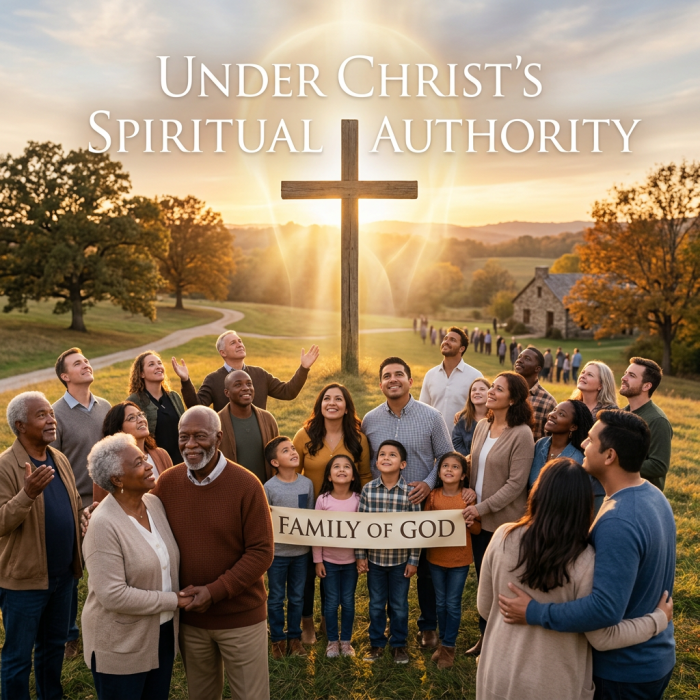
Part 8: Jesus Is the Head
Recovering the New Testament Family
Throughout this series, we’ve asked some difficult questions.
Do spiritual fathers exist?
What about spiritual mothers?
Does every believer need a spiritual covering?
What does biblical submission actually mean?
Does “Touch not my anointed” mean spiritual leaders cannot be questioned?
Do believers need a leader’s permission before obeying what they believe God has called them to do?
And what is the real purpose of apostles, prophets, evangelists, pastors, and teachers?
These questions matter.
But I don’t want to finish this series merely talking about what the Church shouldn’t become.
I want to talk about what the Church should be.
Because the answer to unhealthy spiritual authority isn’t rejecting spiritual authority.
The answer to controlling leadership isn’t leaderless Christianity.
The answer to an unhealthy church isn’t isolation.
The answer to abusive submission isn’t rebellion.
The answer to unhealthy spiritual fathers and mothers isn’t eliminating discipleship.
The answer to misuse of apostolic or prophetic ministry isn’t automatically rejecting everything supernatural.
The answer is actually simpler, but also more challenging.
We need to recover the New Testament picture of the Church under the absolute lordship of Jesus Christ.
Because when Jesus occupies His proper place, everybody else begins finding theirs.
JESUS IS THE HEAD
Paul couldn’t be clearer.
Colossians 1:18 (CSB)says:
“He is also the head of the body, the church…”
Not:
The senior pastor is the head.
Not:
The bishop is the head.
Not:
The apostle is the head.
Not:
The spiritual father is the head.
Not:
The denominational leader is the head.
Jesus is the Head.
This is more than just theological language.
It should affect how churches actually operate.
A body receives direction from its head.
The head coordinates the body.
The head gives direction.
The body exists in submission to the head.
So if Christ is truly the Head of the Church, then every other form of spiritual authority must remain beneath His authority.
Every pastor.
Every elder.
Every apostle.
Every prophet.
Every evangelist.
Every teacher.
Every ministry leader.
Every Christian.
All of us are under Christ.
THE CHURCH BELONGS TO JESUS
Pastors sometimes say:
“My church.”
I understand what we mean.
I might use the phrase conversationally myself.
But spiritually, we need to remember:
It isn’t our church.
Jesus said in Matthew 16:18:
“I will build my church…”
His Church.
Jesus purchased her.
Jesus builds her.
Jesus leads her.
Jesus protects her.
Jesus disciplines her.
Jesus loves her.
Jesus will present her to Himself.
Pastors are stewards.
We aren’t owners.
That’s why Peter tells elders in 1 Peter 5:2:
“Shepherd God’s flock among you…”
Whose flock?
God’s.
That should profoundly affect pastoral leadership.
When I’m dealing with someone in the congregation, I’m dealing with someone who belongs to Jesus.
When I counsel them, they belong to Jesus.
When I correct them, they belong to Jesus.
When I preach to them, they belong to Jesus.
When they disappoint me, they still belong to Jesus.
When they disagree with me, they still belong to Jesus.
Even if they eventually leave the congregation, they still belong to Jesus.
A pastor who remembers that will lead differently.
JESUS IS THE CHIEF SHEPHERD
Peter gives pastors another important reminder in 1 Peter 5:4:
“And when the chief Shepherd appears…”
Jesus is the Chief Shepherd.
That means every other shepherd is an under-shepherd.
Pastors really do have authority.
They really do oversee.
They really do correct.
They really do protect.
They really do lead.
But always under Jesus.
A shepherd cannot legitimately use authority contrary to the Chief Shepherd.
That’s the boundary.
GOD IS OUR FATHER
This brings us back to where the series began.
Jesus said in Matthew 23:9:
“Do not call anyone on earth your father, because you have one Father, who is in heaven.”
As we discussed earlier, Jesus wasn’t prohibiting normal biological language.
Paul himself uses father imagery.
But Jesus was confronting religious status and hierarchy.
And immediately surrounding that statement is another beautiful declaration:
“You are all brothers and sisters.”
That’s the family Jesus is creating.
God is our Father.
Jesus is our Lord.
And we are brothers and sisters.
That doesn’t eliminate leadership.
It changes the spirit in which leadership operates.
The pastor isn’t a king ruling subjects.
He is a brother entrusted with shepherding responsibility.
The apostle isn’t royalty.
He is a servant sent by Christ.
The prophet isn’t an oracle whose words can never be questioned.
Prophetic ministry operates within Christ’s body and is evaluated biblically.
The teacher isn’t the source of truth.
The teacher serves the truth God has revealed.
Different responsibilities.
Different gifts.
Different levels of maturity.
But one family.
JESUS REDEFINED LEADERSHIP
The disciples struggled with this.
They argued about greatness.
They wondered about position.
They wanted prominence.
It sounds remarkably modern.
Jesus responded in Matthew 20:25–28 by pointing out how Gentile rulers “lord it over” people.
Then He said:
“It must not be like that among you.”
That statement should be written across every Christian leadership conference.
“It must not be like that among you.”
Kingdom leadership must look different.
Jesus continues by explaining that greatness in His kingdom is demonstrated through service.
Then He points to Himself.
The Son of Man didn’t come to be served but to serve and give His life as a ransom for many.
That’s our leadership model.
Not celebrity.
Not corporate power.
Not religious royalty.
Jesus.
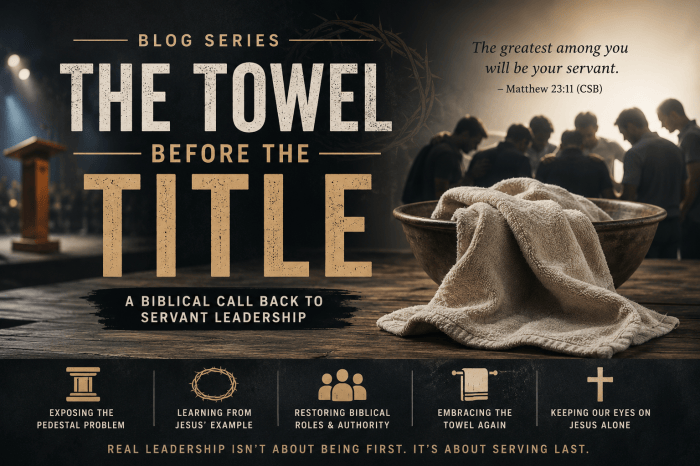
JESUS WASHED FEET
John 13 gives us one of the most powerful pictures of spiritual authority imaginable.
Jesus knows exactly who He is.
He knows where He came from.
He knows where He is going.
And what does He do?
He takes a towel.
He washes feet.
Think about that.
The highest authority in the room performs the lowest servant’s task.
That’s kingdom authority.
Secure authority doesn’t constantly need to prove that it is in charge.
Jesus didn’t need a special chair.
He didn’t need everyone carrying His Bible.
He didn’t need people announcing His titles.
He knew who He was.
So He served.
Imagine what church leadership would look like if John 13 shaped our understanding of authority as strongly as Hebrews 13:17.
Yes, believers should respond appropriately to spiritual leadership.
But leaders should also wash feet.
Not necessarily literally every Sunday.
But in posture.
In humility.
In service.
THE HOLY SPIRIT DWELLS IN GOD’S PEOPLE
Another reality radically shapes New Testament community.
Under the New Covenant, the Spirit of God doesn’t dwell only upon a few elite leaders.
He dwells within God’s people.
Paul asks believers in 1 Corinthians 6:19 whether they know that their bodies are temples of the Holy Spirit.
The Spirit isn’t reserved for the pastor.
The Spirit isn’t reserved for the prophet.
The Spirit isn’t reserved for the apostle.
Every genuine believer has the Holy Spirit.
That doesn’t mean every believer is equally mature.
It doesn’t mean everybody has the same gifts.
It doesn’t mean we don’t need teachers.
But it does mean spiritual leaders must never act as though they have access to God that ordinary Christians cannot.
THE WORD IS AVAILABLE TO THE PEOPLE
Imagine living centuries ago when ordinary believers didn’t have personal access to Scripture the way many of us do today.
Now many Christians have multiple Bibles.
We have Scripture on our phones.
We can compare translations.
We can study context.
That privilege creates responsibility.
Don’t outsource your Bible reading to your pastor.
Listen to sermons.
Absolutely.
Receive teaching.
Absolutely.
But open Scripture yourself.
Read.
Study.
Ask questions.
Learn.
Be like the Bereans in Acts 17:11, who examined Scripture to see if what they heard was true.
Healthy pastors should celebrate that.
WE NEED PASTORS
After everything we’ve discussed, someone might conclude:
“So pastors aren’t that important.”
That’s not my conclusion at all.
We desperately need pastors.
Real pastors.
Shepherds.
People who know the sheep.
People who preach truth.
People who protect against wolves.
People who sit beside hospital beds.
People who counsel broken marriages.
People who bury loved ones.
People who celebrate restoration.
People who correct error.
People who pray.
People who teach.
People who carry burdens nobody else knows about.
People who watch over souls knowing they’ll answer to God.
We don’t need less pastoral leadership.
We need more biblical pastoral leadership.
WE NEED SPIRITUAL FATHERS
Yes, after an entire series questioning some uses of that terminology, I believe we need spiritual fathers—in the relational sense Paul demonstrated.
We need mature men who will invest in younger men.
We need older ministers helping younger ministers.
We need believers who can say:
“Walk with me.”
“I’ve made some mistakes you don’t need to repeat.”
“Let me show you what I’ve learned.”
“Let me pray with you.”
“Let me correct you.”
“Let me encourage you.”
“Let me help you become everything Jesus is calling you to become.”
That’s beautiful.
Just don’t build a throne out of it.
WE NEED SPIRITUAL MOTHERS
We need Titus 2 women.
Women who have walked with Jesus.
Women who know Scripture.
Women who have endured difficulty.
Women who can teach younger women.
Women who can encourage.
Women who can correct.
Women who can demonstrate faithfulness.
Women who can love someone so deeply that, like Paul speaking of Rufus’s mother inRomans 16:13, somebody can truthfully say:
“She became like a mother to me.”
That’s beautiful too.
Again:
Relationship.
Not rank.
WE NEED ACCOUNTABILITY
Nobody should walk alone.
Especially leaders.
Pastors need people who can ask them hard questions.
“How is your marriage?”
“How is your thought life?”
“What are you watching?”
“How are you handling money?”
“Are you becoming prideful?”
“Are you exhausted?”
“Are you treating people well?”
“Are you secretly struggling?”
Those conversations matter.
A title doesn’t provide accountability.
Relationships do.
I would rather have three people who genuinely know me and can confront me than fifty famous names supposedly serving as my “covering” but who know nothing about my life.
WE NEED SUBMISSION
Submission isn’t a dirty word.
Pride doesn’t become spiritual merely because someone had a bad experience with leadership.
Sometimes we need to submit.
Sometimes our pastor sees something we don’t.
Sometimes an elder’s correction hurts because it’s true.
Sometimes we need to stop defending ourselves and listen.
Sometimes we need to trust leadership decisions.
There are times maturity means saying:
“I was wrong.”
But biblical submission never requires replacing Jesus with another human being.
WE NEED DISCERNMENT
John tells believers in 1 John 4:1 not to believe every spirit but to test the spirits.
Paul tells believers to test everything.
Prophetic speech is evaluated.
Teaching is measured by Scripture.
Discernment isn’t rebellion.
It’s part of Christian maturity.
But discernment isn’t cynicism either.
Some Christians become suspicious of everyone.
Every pastor is controlling.
Every large church is compromised.
Every prophet is false.
Every ministry is corrupt.
That’s not discernment.
That’s suspicion.
Biblical discernment is humble enough to test and humble enough to receive what is good.
WE NEED EACH OTHER
The New Testament doesn’t envision Christianity as:
“Me, Jesus, and my Bible.”
It envisions a body.
1 Corinthians 12 describes many members working together.
You need people.
And people need you.
You have weaknesses; somebody else’s gift can strengthen them.
You have gifts somebody else needs.
You have blind spots.
So do I.
That’s why isolation is dangerous.
The answer to unhealthy church culture isn’t abandoning the body.
It’s pursuing healthy biblical community.
THE GOAL ISN’T DEPENDENCE ON LEADERS
Return to Ephesians 4:11–16.
Christ gives leaders to equip saints.
The saints do ministry.
The body grows.
Believers mature.
They become stable.
They speak truth in love.
And then Paul describes the entire body growing from Christ.
That’s the goal.
Healthy leadership doesn’t say:
“How can I make these people need me more?”
It asks:
“How can I help these people know Jesus better?”
That’s a radically different ministry philosophy.
WHAT DOES A HEALTHY CHURCH LOOK LIKE?
Imagine a church where pastors genuinely shepherd but don’t control.
Where leaders are honored but aren’t idolized.
Where prophetic ministry operates but is tested.
Where teachers teach Scripture while encouraging people to study on their own.
Where apostles serve Christ’s mission rather than building personal empires.
Where evangelists equip ordinary believers to share Jesus.
Where mature believers disciple younger believers.
Where older women teach younger women.
Where older men invest in younger men.
Where questions are welcomed.
Where correction is received.
Where sin isn’t hidden to protect reputations.
Where accusations aren’t automatically believed either.
Where truth matters.
Where grace matters.
Where accountability matters.
Where restoration matters.
Where everybody understands:
Jesus is Lord.
That sounds like a family worth belonging to.
THE FAMILY TABLE IS ROUND
Maybe we’ve pictured the Church incorrectly.
We sometimes picture a pyramid.
Someone at the top.
Everybody else underneath.
But the New Testament repeatedly gives us another picture.
A body.
A family.
A flock.
A temple.
A bride.
In every picture, Jesus occupies the central position.
He is the Head of the body.
He is the Chief Shepherd of the flock.
He is the cornerstone of the temple.
He is the Bridegroom of the bride.
And through Him, God is our Father.
We may need fewer pyramids and more family tables.
At the family table, there are elders.
There are younger people.
There are mothers.
There are fathers.
There are brothers.
There are sisters.
Different ages.
Different maturity levels.
Different responsibilities.
But nobody is pretending to be the Father.
THE SAFEST PLACE IS UNDER CHRIST
This series is called:
UNDER CHRIST.
That’s intentional.
Because ultimately, that’s where every one of us belongs.
Pastor:
Under Christ.
Apostle:
Under Christ.
Prophet:
Under Christ.
Evangelist:
Under Christ.
Teacher:
Under Christ.
Spiritual father:
Under Christ.
Spiritual mother:
Under Christ.
Church member:
Under Christ.
Every one of us.
We don’t need leaders who stand between people and Jesus.
We need leaders who stand beside people and continually point toward Jesus.
We don’t need spiritual parents collecting sons and daughters.
We need mature believers raising disciples.
We don’t need “coverings” that make people afraid to leave.
We need communities so healthy people are grateful to belong.
We don’t need pastors afraid of questions.
We need pastors confident enough in Scripture to say:
“Open your Bible and check what I’m telling you.”
We don’t need followers who refuse correction.
We need humble believers who remain teachable.
We don’t need untouchable leaders.
We need accountable leaders.
We don’t need Christians who are independent.
We need Christians who are mature.
ONE FATHER. ONE HEAD. ONE FAMILY.
That could summarize the entire series.
One Father.
God.
One Head.
Jesus Christ.
One family.
The Church.
Inside that family, there are countless relationships.
Pastors.
Elders.
Teachers.
Mentors.
Fathers in the faith.
Mothers in the faith.
Brothers.
Sisters.
Friends.
Disciple-makers.
Counselors.
Leaders.
Servants.
People who correct us.
People who encourage us.
People who walk beside us through our darkest seasons.
Thank God for every one of them.
Honor them.
Love them.
Learn from them.
Listen when they correct you.
Seek their wisdom.
Walk in accountability.
Submit where Scripture calls you to submit.
Serve faithfully within Christ’s body.
But never give another human being the place that belongs uniquely to Jesus.
Because the best spiritual father will eventually point beyond himself and say:
“Follow Jesus.”
The best spiritual mother will say:
“Follow Jesus.”
The best pastor will say:
“Follow Jesus.”
The best apostle will say:
“Follow Jesus.”
The best prophet will say:
“Follow Jesus.”
The best teacher will open Scripture and say:
“Look at Jesus.”
And the healthiest Church will continually remind every person who enters its doors:
You belong to Jesus.
He purchased you.
He saved you.
He restored you.
He filled you with His Spirit.
He placed you within His body.
He gave you leaders to equip you.
He gave you brothers and sisters to walk beside you.
He gave you gifts so you could serve others.
And He is growing you toward maturity.
So honor leaders.
Receive discipleship.
Walk in accountability.
Stay teachable.
Serve the body.
Love the family.
Test everything by Scripture.
And above every other voice, title, relationship, ministry, movement, network, and personality,
keep Jesus where He belongs.
At the center.
At the top.
At the Head.
Because when Christ is truly the Head, nobody else needs His seat.
UNDER CHRIST
One Father.
One Head.
One family.
And all of us under Christ.