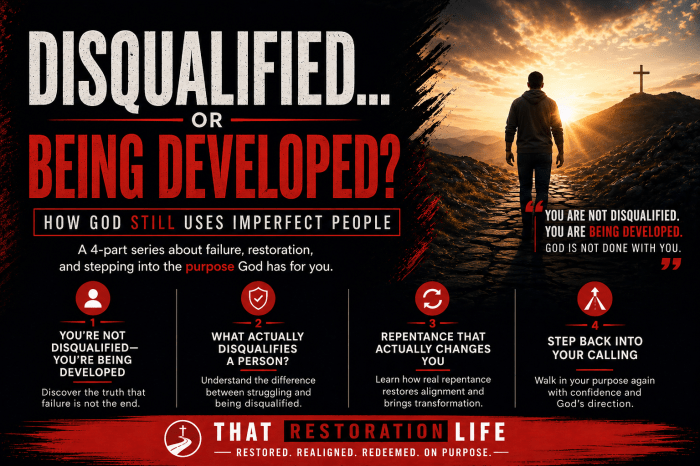
Disqualified… or Being Developed?

How God Still Uses Imperfect People

Part 3 Repentance That Actually Changes You

Repentance is one of the most misunderstood concepts in the church.

Most people think it means:

  • Feeling bad
  • Saying sorry
  • Regretting what happened

But repentance is deeper than emotion.

It is movement.


What Repentance Really Is

Acts 3:19

Repentance is:

  • A change of mind
  • That leads to a change of direction

If direction doesn’t change, repentance isn’t complete.


Why People Stay Stuck

Because they feel conviction—but don’t respond.

They know something is off—but delay action.

And delay creates distance.


What Real Repentance Looks Like

Let’s break it down:

1. Bring It Into the Light

1 John 1:7


2. Confess Clearly

No vague prayers. Be specific.


3. Take Responsibility

No excuses. No blame.


4. Turn From It

Proverbs 28:13


5. Remove Access

If nothing changes around you, nothing changes in you.


6. Replace the Pattern

Romans 12:2


7. Stay Accountable

James 5:16


What Happens When You Do This

  • You are forgiven
  • You are cleansed
  • You are realigned

And alignment restores:

  • Clarity
  • Confidence
  • Direction

Final Thought

You are not restored by waiting.

You are restored by responding.

Disqualified… or Being Developed?

How God Still Uses Imperfect People

Part 2: What Actually Disqualifies a Person?

Let’s clear something up.

If failure disqualified people,
no one would qualify.

So what actually does?

Because Scripture is clear:

God is full of grace—but He is also clear about alignment.


Two Dangerous Extremes

When people don’t understand this, they fall into one of two traps:

  1. False condemnation
    “I messed up, so I’m done.”
  2. Casual compromise
    “Grace covers everything, so it doesn’t matter.”

Both are wrong.

God calls us to neither.


What Disqualification Is Really About

Disqualification is not about imperfection.

It’s about misalignment.

Amos 3:3

You cannot walk with God
while resisting what He is saying.


Patterns That Disqualify

Let’s make it clear.

These are the real issues:

1. Unrepentant Sin

Psalm 66:18

Not struggling with sin—but holding onto it.


2. Ongoing Disobedience

1 Samuel 15:22

Knowing what God said—and choosing otherwise.


3. Pride

James 4:6

Refusing correction. Avoiding accountability.


4. Hypocrisy

Saying one thing. Living another.


5. Wrong Motives

Pursuing influence, not God.


6. Lack of Character

1 Timothy 3:1–7

Gifting without integrity is dangerous.


7. Unbelief

Hebrews 11:6

Not trusting God enough to move forward.


The Key Distinction

You are not disqualified because you struggle.

You are disqualified when you refuse to align.

That’s the line.


Why This Matters

Because many people are living under condemnation
for things that should lead to growth.

And others are living in compromise
when they should be confronting issues.

Clarity matters.


Final Thought

God doesn’t require perfection.

He requires surrender.

Disqualified… or Being Developed?

How God Still Uses Imperfect People

Part 1 You’re Not Disqualified—You’re Being Developed

There’s a lie many believers carry, but few say out loud:

“I messed up too much for God to use me.”

It doesn’t always sound that direct. Sometimes it shows up as hesitation.

You don’t pray like you used to.
You don’t step out like you once did.
You hold back when you feel God prompting you.

You’re still around. Still present. Still believing.

But something has shifted.

And if you’re honest, the shift didn’t start with God.

It started with how you see yourself.


The Internal Conversation

After failure, something begins to happen internally.

You replay the moment.
You question your decisions.
You measure who you are now against who you used to be.

And slowly, the narrative changes.

Not just:
“I made a mistake…”

But:
“I’m not who I was.”
“I can’t be trusted.”
“I’m probably done.”

That’s where the lie settles in.

Not loud. Not dramatic.

But steady.

“You’re disqualified.”


The Problem With That Belief

The problem is not just emotional—it’s theological.

Because when you believe you are disqualified, you begin to:

  • Withdraw instead of engage
  • Stay silent instead of step forward
  • Avoid responsibility instead of embracing it

Not because God removed you.

But because you removed yourself.


What Scripture Actually Shows

If failure disqualified people, Scripture would be empty.

Let’s be honest about who God used:

  • Moses had anger issues and insecurity
  • David committed serious moral failure
  • Peter denied Jesus publicly

These aren’t minor mistakes.

These are defining moments.

And yet—God still used them.

Why?

Because failure was not the deciding factor.

Response was.


The Shift You Have to Make

The issue is not:

“Have you failed?”

The issue is:

“What did you do after you failed?”

That’s where everything changes.

Because failure moves in two directions:

  • Failure + repentance = development
  • Failure + resistance = disqualification

Same moment. Different response. Different outcome.


Conviction vs. Condemnation

One of the biggest misunderstandings in the Christian life is confusing conviction with condemnation.

Romans 8:1

Conviction says:
“You were wrong—come back.”

Condemnation says:
“You are wrong—stay away.”

Conviction pulls you toward God.
Condemnation pushes you away from Him.

If what you’re hearing is pushing you away from God,
it’s not His voice.


What Failure Is Actually Doing

Failure doesn’t just expose weakness.

It reveals areas that need alignment.

It shows:

  • Where discipline is lacking
  • Where dependence is needed
  • Where growth must happen

And when you respond correctly, failure becomes formation.


Why Many People Stay Stuck

Not because they failed.

But because they stopped responding.

They feel conviction—but delay repentance.
They recognize the issue—but avoid dealing with it.

And over time, distance grows.

Not because God moved.

But because they stopped moving toward Him.


The Truth You Need to Accept

You are not disqualified because you failed.

You are disqualified when you refuse to respond.

That’s the difference.

And that difference changes everything.


A Personal Question

Where have you pulled back?

Where have you stopped stepping forward?

Where have you believed something about yourself
that God never said?

Because if you don’t confront the lie,
you will live beneath what God has for you.


Final Thought

You are not disqualified.

You are being developed.

And God is not done with you.

When the Storm Comes: Finding Faith in the Midst of Chaos

Life has a way of catching us off guard. One moment, everything seems manageable, and the next, we’re standing in the middle of chaos we never saw coming. Sometimes these storms arrive not because we’ve done anything wrong, but precisely because we’re doing everything right.

The Disciples’ Dilemma

In Mark chapter 4, we encounter a familiar yet profound story. The disciples find themselves in a terrifying situation—not because they rebelled or disobeyed, but because they followed Jesus’ direct instructions. He told them to get in the boat and cross to the other side. They did exactly that. And then the storm hit.

These weren’t novices on the water. Most of them were experienced fishermen who had weathered countless storms on the Sea of Galilee. But this storm was different. This was a “great windstorm,” the kind that swamps boats and threatens lives. The waves crashed over the sides, filling their vessel with water, and fear began to overtake them.

Here’s the truth we often miss: obedience doesn’t guarantee smooth sailing. In fact, sometimes the moment we decide to follow God’s call is precisely when the winds pick up and the waves start crashing.

The Lie We’ve Believed

Somewhere along the way, many of us bought into a dangerous lie: that walking with Jesus means avoiding all difficulty. We’ve been sold a version of faith that promises rose-colored glasses and golden roads. But that’s not what Scripture teaches, and it’s certainly not what the early followers of Jesus experienced.

Consider the apostle Paul—shipwrecked, stoned, beaten, and bitten by snakes. Or John, exiled to an island to die alone. James, the brother of Jesus, was literally split in two. Peter hung upside down on a cross. These weren’t people living in rebellion. They were the most faithful followers of Christ, yet their lives were marked by intense trials.

The promise Jesus makes isn’t that we’ll avoid storms. The promise is that He’ll never leave us in them.

Jesus in the Boat

While the disciples panicked, Jesus slept. Not because He didn’t care, but because He didn’t need to worry. The storm that terrified seasoned fishermen posed no threat to the Creator of wind and waves.

When they finally woke Him, their question revealed their deepest fear: “Teacher, don’t you care that we’re going to die?”

How often do we ask the same question when our storms rage? Don’t you care that I got this diagnosis? Don’t you care that my finances are crumbling? Don’t you care that my family is falling apart?

Jesus’ response is telling. He stood up, rebuked the wind, and said to the sea, “Silence. Be still.” Immediately, the wind ceased and there was a great calm.

Then He turned to His followers with a penetrating question: “Why are you afraid? Do you still have no faith?”

Nothing Disobeys the Creator

Here’s a remarkable truth: nothing in creation has ever disobeyed Jesus.

The serpent in the garden? Cursed to crawl on its belly, and it still does to this day. The fig tree Jesus cursed? Never produced fruit again. Water turned to wine when He commanded it. The rocks themselves would have cried out in worship if the people had been silenced.

Wind and waves, disease and death—all of creation recognizes its Creator and responds to His voice. The only beings who have ever rebelled against God are humans and angels. Yet even in their rebellion, they remain under His authority.

Satan himself, when given permission to test Job, stayed within the exact boundaries God set. He understood that God’s word is absolute, that when God said “this far and no farther,” there was no room for negotiation.

Fear Versus Faith

Our fear grows when our faith shrinks. When we focus more on the storm in front of us than on the One who created the storm, anxiety takes over.

The disciples weren’t afraid of storms in general—they’d weathered plenty. Their fear was that Jesus didn’t care, that perhaps He wasn’t who they thought He was. Their fear was rooted in doubt about His character, not in the circumstances themselves.

God’s silence is not God’s absence. Jesus was asleep in the boat, but He was still present. Sometimes God allows us to face situations where He seems quiet, not because He’s abandoned us, but because He’s testing where our faith truly lies.

If Jesus can save our souls—taking what was dead and making it alive—why would we doubt His ability to handle our temporal circumstances? If He proved His love by sending His Son to die for us while we were still His enemies, how much more will He care for us now that we’re His children?

The Purpose of the Storm

Sometimes storms are assignments, not attacks. God may allow difficulty in our lives not to punish us, but to position us for His greater purpose.

Consider this: everything that happens in our lives must filter through God’s hands. He doesn’t cause all things, but He allows all things, and He works all things together for the good of those who love Him and are called according to His purpose (Romans 8:28).

That “good” isn’t always our immediate comfort. The very next verse reveals the goal: we’re being conformed to the image of His Son. Transformation requires refinement. Things must be burned off, broken off, beaten off so we can better reflect Christ to a watching world.

Sometimes we go through storms not for our own sake, but for someone else’s. Our testimony in the midst of trial may be exactly what leads another person to faith. Our steadfastness when everything is falling apart might be the only sermon someone needs to hear.

Indestructible Until God Decides

Here’s a liberating truth: you are virtually indestructible until God decides your time is done.

Paul was left for dead multiple times, yet he kept preaching. Why? Because his assignment wasn’t finished. When our purpose on earth is complete, we’ll step into eternity. Until then, no storm, no enemy, no circumstance can take us out ahead of schedule.

This doesn’t mean we live recklessly. It means we live fearlessly. We don’t have to be paralyzed by “what ifs” because we know the One who holds tomorrow. Whether our country changes, whether our health fails, whether our finances crumble—our faith isn’t in circumstances. Our faith is in the One who sits on the throne of heaven.

The Transformation Goal

After Jesus calmed the storm, the disciples asked each other, “Who then is this? Even the wind and the sea obey him.”

The storm gave them a new revelation of who Jesus was. Your trial can do the same. When you face your storm with faith instead of fear, when you trust God’s character even when you can’t see His hand, you’ll discover dimensions of His power and love you never knew existed.

The goal of every storm is transformation—not just our own, but potentially the transformation of everyone watching how we respond. Our faith in the fire becomes their invitation to believe.

So when the storm comes—and it will come—remember that Jesus is in the boat. He may be silent, but He’s not absent. The waves may crash and the wind may howl, but nothing in your life is outside His authority. Let your faith be bigger than your fear, and watch what God does through your storm.
The Dangerous Gap: Compliance vs Submission. PART 4: From Behavior to Heart Change

Here’s the final truth:

God is not trying to fix your behavior.

He’s trying to transform your heart.


Why Behavior Change Isn’t Enough

You can:

  • stop doing something
  • adjust your habits
  • clean things up externally

But still go back.


Why?

Because the root didn’t change.


Jesus Makes It Clear

Luke 6:45

“For his mouth speaks from the overflow of the heart.”


What comes out of your life…

comes from your heart.


The Difference

Behavior management:

  • temporary
  • external
  • effort-driven

Transformation:

  • lasting
  • internal
  • surrender-driven

What Real Change Looks Like

  • Your reactions shift
  • Your desires change
  • Your resistance decreases
  • Your obedience becomes natural

Not because you tried harder…

But because you surrendered deeper.


The Final Truth

You don’t need:

  • more rules
  • more pressure
  • more effort

You need surrender.


Final Reflection

Are you trying to manage behavior…

or surrender your heart?

Because that answer determines everything.

The Dangerous Gap: Compliance vs Submission. PART 3: What True Submission Looks Like

Submission is not weakness.

It’s alignment.


It’s saying:

“God, not my will… but Yours.”


Where It Begins

James 4:7

“Therefore, submit to God. Resist the devil, and he will flee from you.”

Notice the order:

Submission comes first.


Why This Matters

Many people try to:

  • fix behavior
  • fight temptation
  • manage struggles

Without surrendering.

And it doesn’t work.


What Submission Looks Like

Submission is:

  • letting go of control
  • trusting God without full understanding
  • obeying when it’s uncomfortable

Jesus Modeled This

Luke 22:42

“Not my will, but yours, be done.”


That’s the standard.


A Real-Life Moment

Submission shows up when:

  • you forgive when you don’t want to
  • you release something you value
  • you trust God when it doesn’t make sense

The Truth About Control

Control feels safe.

But it keeps you stuck.


Surrender feels risky.

But it leads to freedom.


Reflection

What are you still trying to control…

that God is asking you to surrender?

The Dangerous Gap: Compliance vs Submission. PART 2: The Danger of Compliance

Compliance is dangerous…

Because it looks like obedience.


It feels like progress.

It sounds spiritual.

But underneath—it can still be resistance.


The Deception of “Almost”

No one says:

“I’m going to partially obey God.”

Instead, we say:

  • “I’m working on it”
  • “God understands”
  • “I’m doing better”

And while some of that can be real…

It can also be a mask.


Saul’s Example

1 Samuel 15:22

“Does the LORD take pleasure in burnt offerings and sacrifices as much as in obeying the LORD?”

Saul obeyed—partially.

But he kept what he wanted.

Adjusted what he didn’t agree with.

And justified it.


God rejected it.


Why Partial Obedience Is Still Disobedience

Because it keeps you in control.

It says:

“God, I’ll follow You… but on my terms.”


Modern Examples

  • “I forgave them… but I won’t talk to them.”
  • “I stopped most of it.”
  • “I’ll obey later.”

That’s not submission.

That’s negotiation.


The Real Issue

You don’t need more effort.

You need surrender.


Because partial obedience keeps the root alive.

And what you don’t fully surrender…

Will continue to control you.


Reflection

What has God told you clearly…

that you’ve only partially obeyed?

That’s where your breakthrough is.

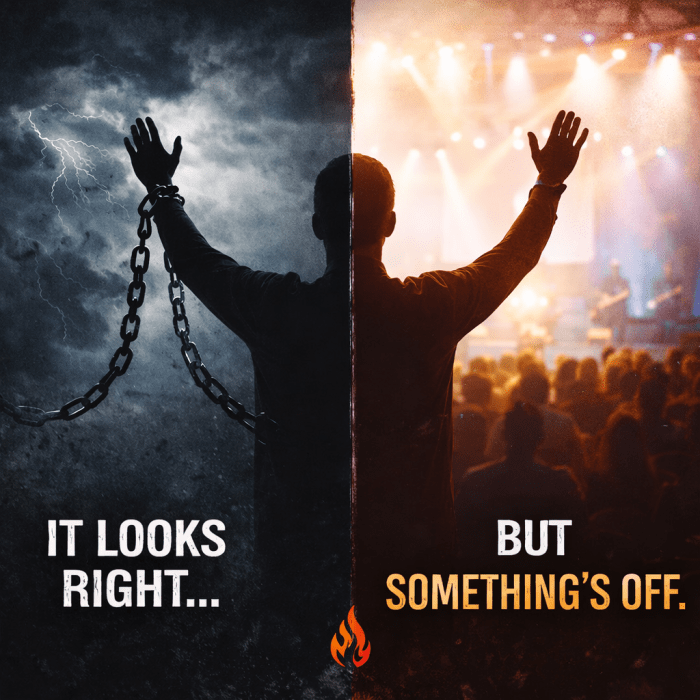
The Dangerous Gap: Compliance vs Submission. PART 1: You’re Doing It Right… But Still Wrong

There’s a reality many people don’t want to admit:

You can be doing everything right…
and still be wrong.

You can attend church consistently.
Serve faithfully.
Say the right things.
Avoid obvious sin.

From the outside, your life looks solid.

But on the inside?

Something feels off.

There’s still frustration.
Still cycles.
Still a lack of real change.

And the question is—why?

The answer is simple, but uncomfortable:

Because doing right is not the same as being surrendered.


The Hidden Gap

There is a gap that many believers live in without realizing it.

It’s the gap between:

  • compliance
  • and submission

Compliance says:
“I’ll do what I’m supposed to do.”

Submission says:
“I give God my will.”

And those are not the same thing.


You Can Obey Without Surrendering

Scripture exposes this clearly:

Matthew 15:8

“This people honors me with their lips, but their heart is far from me.”

Jesus wasn’t addressing rebellion.

He was addressing people who looked right—but weren’t surrendered.

They had:

  • the right language
  • the right actions
  • the right appearance

But the wrong heart.


A Real-Life Reality

I’ve sat with people who said:

“Pastor, I don’t understand. I’m doing everything right… but nothing is changing.”

And when you start asking deeper questions, it comes out:

They’re obeying externally…
but resisting internally.

They forgave—but still hold bitterness.
They serve—but still want control.
They show up—but haven’t surrendered.


Why This Matters

Because compliance can maintain behavior…

But it cannot transform your life.

It leads to:

  • pressure instead of peace
  • effort instead of freedom
  • cycles instead of change

Eventually, you either burn out…
or you start slipping back.


The Real Question

Not:
“What am I doing right?”

But:

👉 “What have I not surrendered?”

Because God is not just after your behavior.

He’s after your heart.


A Simple Truth

You can:

  • look right
  • act right
  • sound right

…and still not be fully surrendered to God.

But the moment you surrender your will…

Everything begins to change.


Reflection

Where in your life are you doing the right thing…
but still holding onto control?

That’s the gap.

And that’s where God wants to work.

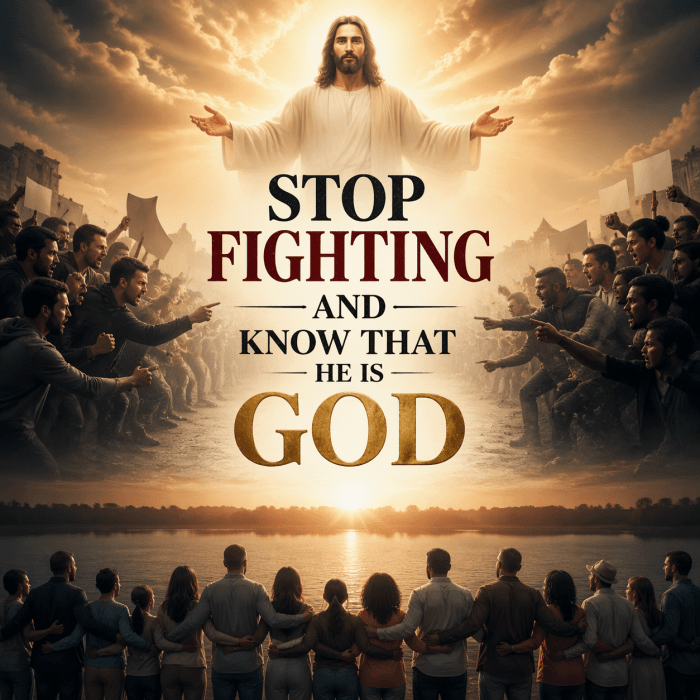
Stop Fighting and Know That He Is God

Life has a way of becoming overwhelmingly chaotic. The bills pile up, relationships strain, health concerns emerge, and suddenly we find ourselves drowning in circumstances beyond our control. We run from crisis to crisis, carrying burdens that were never meant for our shoulders, fighting battles that aren’t ours to win.

But what if the answer to our chaos isn’t to fight harder, but to stop fighting altogether?

When God Slows Us Down

Sometimes God uses the most unexpected circumstances to get our attention. It might be a job change, an illness, a financial setback, or even something as simple as being placed in a 10×16 shed selling buildings. Whatever the method, God knows exactly how to slow us down when we’ve gotten too busy to hear Him.

The problem isn’t always that we’re doing bad things. Often, we’re doing good things—helping people, serving, working hard—but we’ve stopped listening. We’ve taken on everyone else’s burdens and forgotten that Jesus already carried them to the cross. We’ve become so caught up in the noise of expectations, ministry demands, and constant problem-solving that we can no longer hear His still, small voice.

God hasn’t moved. He hasn’t gone on vacation. Our awareness has simply shifted away from Him.

The Power of Focus

Psalm 46 paints a vivid picture of chaos: mountains toppling, waters roaring, earth trembling. Life feels exactly like that sometimes, doesn’t it? The ground beneath our feet seems unstable, the noise around us deafening, the circumstances overwhelming.

Yet in the middle of that same psalm, the imagery shifts dramatically. Suddenly there’s a river with streams that delight the city of God. There’s peace. There’s security. There’s the promise that God is within her, and she will not be toppled.

What changed? The circumstances didn’t. The chaos was still present. What changed was the focus.

When we focus on chaos, life looks impossible. When we focus on God, we see that He’s been there all along, unmoved by what moves us, unshaken by what shakes us. It’s like frantically searching for your phone while it’s in your hand, or tearing apart the house looking for something that’s exactly where your spouse said it was. God is right where He’s always been—we’re just moving too fast to see Him.

The Gospel of “Stop Fighting”

Most of us know Psalm 46:10 as “Be still and know that I am God.” But another translation captures something powerful: “Stop your fighting and know that I am God.”

This isn’t a gentle suggestion to pause for a moment of meditation. It’s a command to stop fighting battles that aren’t ours. Stop trying to fix everyone’s problems. Stop carrying burdens God never asked us to carry. Stop defending ourselves when God has promised to fight for us.

The church is called to be on offense, not defense. The gates of hell won’t prevail against the church—but only when we’re attacking those gates, not cowering behind our own. When we stop fighting defensively and start trusting God offensively, something remarkable happens: He is exalted among the nations, exalted on the earth.

God doesn’t need our frantic efforts. He needs our obedience. He doesn’t need us to manufacture results. He needs us to be faithful to what He’s called us to do and trust Him with everything else.

What Are You Carrying?

Imagine trying to carry not just your own Bible, but everyone else’s too. At first, adding one more isn’t difficult. But as the pile grows—taking on this person’s problems, that person’s burdens, someone else’s calling—eventually you collapse under the weight of things that were never yours to carry.

We’re each responsible for our own walk with God. Yes, we should pray with one another, encourage one another, and bear one another’s burdens in love. But there’s a difference between supporting someone and taking ownership of their relationship with God.

When we carry everyone else’s Bible, theirs never gets worn out from use. It gets worn out because we drop it while juggling too many things. Meanwhile, our own relationship with God suffers because we’re too busy trying to be everyone else’s savior.

Jesus already filled that role. We don’t need to apply for the position.

Three Questions for Your Soul

Where has life become too loud? Is it your job, your phone, your health concerns, your children, your finances? What noise is drowning out the voice of God?

What are you carrying that isn’t yours to carry? Whose problems have you taken ownership of? Whose calling are you trying to fulfill instead of your own? What burdens are weighing you down that Jesus is ready to lift?

Where do you need to slow down? What do you need to learn to say “no” to? Ironically, “no” is the first word we learn as children but the hardest to say as adults. Yet sometimes the most spiritual thing we can do is decline an opportunity so we can be faithful to what God has actually called us to do.

Peace Under Pressure

Peace isn’t the absence of chaos. Peace is the presence of God in the middle of chaos. We all know people who remain steady no matter what happens in their lives—they’ve discovered the peace that passes all understanding. They’ve learned that God’s presence isn’t dependent on their circumstances.

When your focus is right, you can receive a devastating diagnosis and still have peace. You can face financial ruin and still trust. You can walk through the valley of the shadow of death and fear no evil, because He is with you.

The Invitation to Slowness

God wants to restore you, but He cannot restore you while you’re busy. He needs you to slow down. Stop fighting. Stop carrying what isn’t yours. Stop focusing on the chaos and start focusing on Him.

He hasn’t moved. He’s not overwhelmed by your circumstances. He’s not surprised by what’s happening in your life. He’s simply waiting for you to realize He has the power to fix it, and He’s waiting for you to become aware that He’s still right there with you.

The good news isn’t good news unless you share it. But you can’t share what you haven’t received. You can’t give away peace you don’t possess. You can’t point others to Jesus when you’ve lost sight of Him yourself.

So stop. Be still. Know that He is God. And watch as He is exalted in your life and through your life.

The chaos may not disappear, but your perspective will transform. And that changes everything.

What Will You Do With the Resurrection?

There’s a profound moment that happens when we truly recognize who Jesus is. Not just intellectually acknowledge Him, not just add Him to our list of beliefs, but genuinely encounter the resurrected Christ. And here’s the uncomfortable truth: once that recognition happens, we’re forced to respond. We don’t get to pocket Jesus like loose change and go about our business as usual.

The Immediate Call to Action

In Luke 24:32-33, we find two disciples who had just walked with Jesus on the road to Emmaus. When they finally recognized Him, the Bible says something remarkable: “That very hour they got up and returned to Jerusalem.” Not the next day. Not after they’d processed everything. Not after they’d figured out how it would all work out. That very hour.

This immediate response challenges our modern tendency to “process” what God is telling us. We’ve become experts at disguising delayed obedience as wisdom. “I’m just trying to figure it out,” we say. “I need to see how it all works.” But delayed obedience is simply disobedience dressed in respectable clothes.

When God calls, He doesn’t promise that the bills will stop coming. He doesn’t guarantee that trials will cease. In fact, when you start living for God, the enemy often ramps up his attacks. But here’s what he can’t do: he can’t make you do anything. The devil is a tempter, not a puppet master. With every temptation, Scripture promises a door of escape—we just have to be looking for it instead of searching for the door of temptation.

You Don’t Need a Theology Degree

When those disciples returned to Jerusalem, they didn’t deliver a theological dissertation. They didn’t quote Scripture perfectly or present a systematic argument for the resurrection. Luke 24:35 tells us they “began to describe what happened on the road and how he was made known to them in the breaking of bread.”

They simply shared their experience.

This is liberating news for those of us who feel inadequate to share our faith. You don’t need to memorize all 1,189 chapters of the Bible. You don’t need to know Greek and Hebrew. You don’t need a seminary education. You just need to know what Jesus did in your life.

Life changes when you experience your theology. The world doesn’t need more people who can recite Bible verses while living unchanged lives. They need to see transformed hearts. They need to read the pages of your story—all the pages, including the ones you’re ashamed of. Because it’s precisely those difficult chapters that demonstrate the power of redemption.

The Power of Testimony

Revelation speaks of believers who “overcome by the blood of the Lamb and the word of their testimony.” Not someone else’s testimony. Not the preacher’s testimony. Your testimony.

Where were you when Jesus found you? What was your life like before He stepped in? What has changed since you encountered the risen Christ? These aren’t trivial questions—they’re the substance of the most powerful evangelism tool you possess.

Some people have dramatic conversion stories—rescued from addiction, pulled from the depths of despair, transformed from a life of chaos. Others were saved young and grew up walking faithfully with God, protected from those pitfalls. Both testimonies are equally powerful. One demonstrates rescue; the other demonstrates preservation. Both reveal a God who is intimately involved in human lives.

Living as Ambassadors

When you’re saved, you become an ambassador for Christ. You’re no longer a resident of this world; you’re just passing through, representing another Kingdom. But here’s the question: would anyone know it?

When a U.S. ambassador travels to another country, people don’t wonder if they’re an ambassador. They know—by the way they dress, the cars they drive, the way they conduct themselves. Everything about them screams their identity.

Yet some believers are so undercover that Jesus Himself might not recognize whose side they’re on. They walked an aisle, said a prayer, got baptized, and thought they’d purchased fire insurance while planning to live exactly as they did before. Same temptations, same habits, same hangups—just with a church membership card.

But true salvation changes you. You won’t want to be the same. You may still face the same struggles—the devil is persistent—but you won’t desire the same outcomes. When you fail, you’ll feel conviction, which is actually evidence that the Holy Spirit is alive in you. God disciplines His children, not the devil’s.

The Buddy Houck Story

Consider the story of Buddy Houck, a man who spent years trapped in alcoholism, sleeping on a broken-down porch with no electricity, estranged from his family. When he encountered Jesus on a Christmas Eve service—drunk and smelling so bad people didn’t want to sit near him—something began to change.

He didn’t have theological training. He didn’t know all the Bible stories. But he recognized Jesus, and it demanded a response. Buddy quit drinking. He reconciled with his mother after twenty years of silence. He reunited with the son he hadn’t seen in two decades and met his grandson for the first time.

God restored what Buddy had walked away from—not because Buddy became a Bible scholar, but because people watched how he lived after encountering Christ. His life became a testimony more powerful than any sermon.

Restoration and Return

Sometimes restoration isn’t about making everything brand new. Sometimes it’s about returning you to what you walked away from, now prepared to do what God originally called you to do. The call of God is without repentance—He doesn’t forget what He’s asked of you just because you walked away.

The prodigal son had everything, squandered it all, and came back crawling. The church often kicks people when they’re down, listing all their failures and disqualifications. But the Father? He runs to embrace the returning child. That’s the heart of God—not condemnation for those who return, but celebration.

What Now?

So what will you do with Jesus? You can’t remain neutral once you’ve recognized who He is. You can’t put Him on like a coat on Sunday and take Him off the rest of the week. The resurrection demands a response—an immediate, life-altering response.

Jesus is returning for a spotless bride, not a compromised church that looks just like the world. He’s coming for those who did something with Him, whose lives were genuinely transformed by encountering the risen Savior.

The question isn’t whether you can quote Scripture or explain complex theology. The question is: Has Jesus changed your life, and are you willing to tell someone about it?

That very hour. Not tomorrow. Not when it’s convenient. Not when you’ve figured it all out.

That very hour.