Why I Believe in Traditional Values—and Why the Modern Left Has Lost Its Way

In a culture dedicated to rebranding everything, defending our foundational principles can seem like heresy. Traditional values are being replaced with new meanings. “Normal” is whatever is current, “conservative” is reactionary, “progress” is creating new standards, and “tolerance” is accepting what others say. But Scripture commands us to endure. 

“For the plans of the Lord are enduring plans; the thoughts of his heart are plans for many generations.” (Psalm 33:11)

I believe in traditional values because they are biblical principles, not just cultural trends. They have served us well for generations, providing stability, dignity, and clarity. I also increasingly believe that the modern political left has lost its way — not because it seeks justice, but because it has rejected truth.

Traditional Values Are God’s Design, Not Human Invention

Family, responsibility, moral boundaries, and order are not social constructs made up by conservatives. They are God’s design. (Proverbs 8:22-29; Isaiah 44:24-28) 

“God created man in his own image… male and female he created them.” (Genesis 1:27)

“Children are a gift from the Lord; offspring are a reward from him.” (Psalm 127:3)

Scripture shows marriage, family, and responsibility as blessings, not burdens. Traditional values defend the most vulnerable, shape identity, and create a foundation for human thriving. When society views these as optional or oppressive, confusion replaces clarity.

The Bible warns against this reversal. 

“Woe to those who call evil good and good evil, who substitute darkness for light and light for darkness.” (Isaiah 5:20)

The Left Replaced Reason With Ideology 

One of the most worrying trends on today’s left is the rejection of open debate. Disagreement is no longer addressed with counterarguments; instead, people are labeled. Questioning progressive ideas can lead to being called hateful, ignorant, or dangerous. This isn’t confidence in ideas; it’s a sign of ideological insecurity.

Scripture warns about this kind of thinking—when emotion and preference replace reason and truth.

“The one who gives an answer before he listens—this is foolishness and disgrace for him.” (Proverbs 18:13)

Free speech, once a core value of liberal thought, is now defended selectively. Science is trusted only when it aligns with political goals. Equity has replaced equality, outcomes have replaced effort, and feelings have overtaken facts.

Yet God calls His people to reason grounded in truth.

“Come, let us settle this,” says the Lord. “Though your sins are scarlet, they will be as white as snow.” (Isaiah 1:18)

When a movement demands conformity rather than conversation, it ceases to be a movement of progress and becomes one of control. The Bible clearly shows this. 

“Now the Lord is the Spirit, and where the Spirit of the Lord is, there is freedom.” (2 Corinthians 3:17)

Victimhood Has Replaced Responsibility 

Traditional values encourage people to rise, persevere, and take responsibility for their lives—even during difficult times. Scripture consistently emphasizes that responsibility is a virtue, not a burden.

“Each person should carry his own load.” (Galatians 6:5)

The modern left increasingly teaches people to identify first as victims and to assign blame externally. This mindset does not empower; it weakens. 

God’s Word takes a different approach. 

“If anyone is not willing to work, he should not eat.” (2 Thessalonians 3:10)

A culture that rewards grievance will always generate more grievance. A society that tells people they are defined by oppression instead of potential robs them of agency and hope.

Responsibility is not cruel. It is dignifying. It says, “You matter enough to be accountable.”

Scripture affirms this dignity. 

“Whatever a person sows he will also reap.” (Galatians 6:7)

When responsibility is removed, chaos fills the vacuum.

“Everyone did whatever seemed right to him.” (Judges 21:25)

Moral Absolutes Are Necessary for a Healthy Society

Traditional values recognize that some things are right and some things are wrong—regardless of public opinion. This is not rigidity; it is moral clarity.

“The fear of the Lord is the beginning of wisdom.” (Proverbs 9:10)

The left’s moral framework, by contrast, constantly shifts. What is praised today might be condemned tomorrow. Language evolves weekly. Standards are applied inconsistently. 

Scripture warns against moral instability. 

“Jesus Christ is the same yesterday, today, and forever.” (Hebrews 13:8)

This moral instability breeds confusion, fear, and hypocrisy.

A society cannot function without shared standards. 

“Righteousness exalts a nation, but sin is a disgrace to any people.” (Proverbs 14:34)

When everything is negotiable, nothing is trustworthy. When truth is flexible, power decides reality. 

“You will know the truth, and the truth will set you free.” (John 8:32)

This Is Not About Hate—It Is About Preservation

Standing for traditional values isn’t about hating others. It’s about preserving what works. It’s about safeguarding the structures that protect children, sustain communities, and give life meaning beyond self-gratification.

Scripture commands both truth and love. 

“Speaking the truth in love, let us grow in every way into him who is the head—Christ.” (Ephesians 4:15)

Disagreement is not violence. Conviction is not bigotry. Believing in truth is not intolerance. 

“Am I now trying to persuade people, or God? Or am I striving to please people?” (Galatians 1:10)

The left has not lost credibility because it cares too much—it’s because it no longer knows what it stands for. When values are detached from reality, they fall apart due to their own contradictions.

“Everyone who hears these words of mine and acts on them will be like a wise man who built his house on the rock.” (Matthew 7:24)

A Return to Sanity 

I believe in traditional values because they are grounded in reality, proven over time, and confirmed by results. They don’t promise perfection—but they provide stability, purpose, and hope.

“Jesus Christ is the cornerstone.” (Ephesians 2:20) 

The future doesn’t belong to those who shout the loudest or cancel the fastest. It belongs to those willing to stand firm when the culture shifts, to speak truth when it’s unpopular, and to preserve what is good even when it’s ridiculed.

“Be alert, stand firm in the faith, be courageous, be strong.” (1 Corinthians 16:13)

Progress does not require abandoning our foundations. 

Sometimes, the most radical thing you can do is stand on solid ground.

“Unless the Lord builds a house, its builders labor over it in vain.” (Psalm 127:1)

Running the Race: Finding Endurance When Faith Is No Longer Fun

Life has a way of starting strong and fading somewhere in the middle. Think about marathon runners—at the starting line, everyone is pumped, energized, ready to conquer the miles ahead. Even the person in the very back, already wondering what they’ve gotten themselves into, isn’t quitting. Not yet. The gun fires, and off they go.

But around mile 13—halfway through the 26.2-mile journey—something changes. The cameras stop rolling. The crowds thin out. The initial adrenaline has long since evaporated. This is where most people quit. Not because they’re angry or because there’s no audience, but simply because they’re tired.

Our spiritual journey mirrors this pattern more than we’d like to admit.

The Middle Miles

Nobody quits following Jesus at the beginning. When someone first encounters Christ, they’re on fire—ready to charge hell with water pistols, as the saying goes. Everything feels fresh, exciting, purposeful. Prayer comes easily. Church attendance is a joy, not an obligation.

But give it time. Life gets hard. Prayers seem unanswered. The battles keep coming. The excitement fades. And somewhere in the middle of the journey, people get tired. They don’t announce they’re quitting. They don’t make a dramatic exit. They just slowly fade away.

Week one of missing church, people notice. Week two, they give you a pass—you’re probably tired. Week three passes. By week four, that person has become a memory, and the cycle continues. It’s not that they wanted to quit. They just got tired of getting up, tired of unanswered prayers, tired of constant battles, tired of filling in whatever blank applies to their situation.

The true test of endurance isn’t what you do when the crowds are cheering. It’s what you do when all the crowds are gone and faith is no longer fun.

A Cloud of Witnesses

Hebrews chapter 12 opens with a powerful reminder: we have “such a large cloud of witnesses surrounding us.” This comes right after chapter 11’s hall of faith—a lineup of biblical heroes who accomplished great things for God.

But here’s what we often miss: at the beginning of their stories, none of these people looked qualified for what God called them to do.

Abraham was a drunk and a liar who worshiped God in a pagan area and disobeyed right out of the gate. Yet he became the friend of God and the father of many nations.

David murdered his best friend to steal his wife. Does that sound like a man after God’s own heart? Yet he was.

Rahab was a Gentile prostitute. And she ended up in the direct lineage of Jesus Christ.

The point? If you think your past disqualifies you, you’re wrong. God specializes in using unlikely people to accomplish impossible things.

Laying Aside What Holds Us Back

The writer of Hebrews urges us to “lay aside every hindrance and the sin that so easily ensnares us.” Notice the language—it’s not that sin traps us against our will. The problem is that we won’t let it go.

We hold onto it. We hide it. We do it in the dark, in the convenience of our homes, acting like no one knows. But Scripture is clear: everything done in darkness will be brought to light.

It’s like an anchor on a boat. Try moving forward when you’re tied to a rock. Even if you manage some progress, you’re dragging that weight with you, exhausting yourself in the process.

The sin isn’t the real issue—it’s our unwillingness to release it. We’ve found some twisted form of security in it, some counterfeit peace in the middle of chaos. Whether it’s addiction, unhealthy relationships, unforgiveness, or any other habitual sin, we know it’s not good for us. We know it hasn’t produced anything positive. But we cling to it anyway.

There’s a powerful story about a man who lived with his girlfriend and their seven children for years, refusing to marry her despite everyone’s urging. One day, someone simply asked him: “What would you do if your daughter was with a guy who had seven children with her but wouldn’t marry her?”

He looked down. Within two weeks, they were married.

He already knew what he was doing was wrong. He just needed the right perspective to be willing to let it go.

Keeping Our Eyes on Jesus

“Keeping our eyes on Jesus, the source and perfecter of our faith.”

Where your eyes are, your life will go. If you focus on money, eventually your life will have nothing else in view except making more of it. If you focus on relationships, achievements, or your children above all else, you’ll bend and break every principle you once held to pursue that focus.

But if your focus is Jesus, nothing will hold you back.

Think about when you tend to get sick or face obstacles. Often it’s Sunday morning when you don’t feel well, or Monday when you planned to spend time with God, or Thursday before church. Someone calls with tickets to the game or an invitation to go fishing right when you’re walking out the door to serve.

The enemy knows exactly when to strike—when you’re trying to focus on what matters most.

People who finish marathons aren’t necessarily the fastest or the strongest. They’re the ones who stay focused on the finish line. Nothing prevents them from getting there. Not the hills, not the competition, not the pain. They’re locked in on the goal.

For the Joy Set Before Him

Here’s the stunning truth: Jesus endured the cross “for the joy that lay before him.” What joy? The joy of spending eternity with us.

Think about that. He created us. He died to save us. He gives us the strength to endure. He’s done it all. And He did it for the joy of being with us forever.

He hung naked on a cross in the busiest street, despising the shame, because He knew the end result would be worth it. He signed a contract in His own blood, and He finishes what He starts.

One Day at a Time

You can’t change yesterday. Tomorrow will have enough challenges of its own. So focus on today. What does Jesus have for you today?

Don’t worry about running the whole marathon right now. Just take the next step. And then the next one. Progress isn’t measured in miles—it’s measured in moments, in choices, in the decision to keep going when everything in you wants to quit.

This is your race. Not someone else’s. What does your walk with Jesus look like today? What is He calling you to do? Whatever it is, the enemy is already preparing obstacles. But remember: the One who began a good work in you will be faithful to complete it.

So when you hit mile 13—when you’re tired, when the crowds are gone, when faith is no longer fun—keep your eyes fixed on Jesus. He’s both the author and the finisher. He’s already at the finish line, and He’s cheering you on.

Just take the next step.

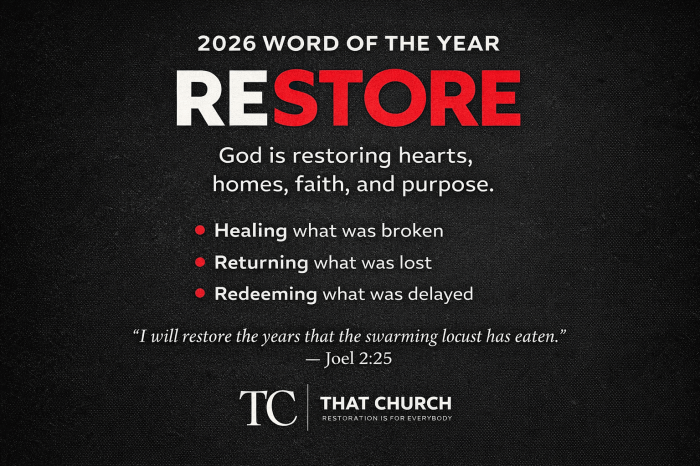
RESTORE: Why This Is the Right Word for the Year

Every year carries its own weight.
Some years stretch us.
Some years break us.
Some years take more than they give.

And if we’re honest, many people are walking into this year carrying losses they never planned for—lost time, broken trust, deferred dreams, strained relationships, weakened faith.

That’s why our word for this year is not accidental.
It’s intentional.
It’s biblical.
It’s hopeful.

Our Word for the Year is: RESTORE.


God Is a Restoring God

Restoration is not a trend.
It’s part of God’s nature.

God doesn’t just forgive—He restores.
He doesn’t just heal—He rebuilds.
He doesn’t just rescue—He renews.

The Lord makes this promise clearly:

“I will restore the years that the swarming locust has eaten.”
— Joel 2:25 (CSB)

Notice what God promises to restore:
Years.

Not just moments.
Not just feelings.
Not just circumstances.

God speaks to time that felt wasted, stolen, or destroyed—and says, “I can redeem even that.”


Restore Is About More Than the Past

Restoration is not living backward.
It’s not pretending the pain didn’t happen.
It’s not erasing history.

Restoration is God taking what was damaged and giving it new strength.
What was delayed and giving it new purpose.
What was broken and giving it new life.

God doesn’t always restore things to the way they were.
Often, He restores them to what they were meant to be.


What Restore Means for This Year

This is a year to believe God for more than survival.

  • Restored hearts — healing from grief, bitterness, and disappointment
  • Restored faith — trust that has been shaken but not destroyed
  • Restored relationships — forgiveness, reconciliation, and peace
  • Restored purpose — clarity where confusion once lived
  • Restored joy — strength rising where weariness settled in

Restoration is not rushed.
It’s intentional.
It’s often gradual.
But it is always guided by God’s hand.


Restore Requires Participation

God restores—but He invites us to walk with Him in the process.

Restoration asks us to:

  • Let go of what we cannot change
  • Release what we were never meant to carry
  • Obey God in the small steps
  • Trust Him with the timeline

Restoration doesn’t begin with everything changing around us.
It begins with God changing something within us.


A Declaration for the Year

This year, we are choosing to believe that God is not finished.

Finished with your story.
Finished with your calling.
Finished with your family.
Finished with your future.

He restores what life tried to take.
He redeems what the enemy tried to ruin.
He renews what felt too far gone.

This is a year of RESTORE.


A Simple Prayer

Lord, I place this year in Your hands. Restore what has been broken, strengthen what is weak, and redeem what was lost. Teach me to trust You with the process and to walk forward in faith. I believe You are still restoring. Amen.


Final Thought:
God is not intimidated by what you’ve lost.
He specializes in restoration.

This is the year to believe again.
This is the year to heal again.
This is the year to walk restored.

Forgive yesterday to live faithfully today 

We are so tired. Not because of what’s going on today, but because of what we’re still carrying from yesterday, and what we’re afraid might happen tomorrow. 

Regret has a way of replaying yesterday’s scenes. Anxiety has a way of borrowing tomorrow’s trouble that hasn’t yet arrived. And somewhere in the middle, today gets overlooked. 

Jesus speaks into the tension. 

“So don’t be anxious about tomorrow, for tomorrow will be anxious enough about itself. Each day has enough trouble of its own.” — Matthew 6: 34 (CSB) 

Jesus doesn’t say tomorrow doesn’t matter. He says it doesn’t belong to you yet. Yesterday Is Informative—Not Authoritative. Yesterday can inform you. It can teach you. It can warn you. But yesterday should never dictate your tomorrow. God never intended for your past to become your prison. Paul knew this. He commands us to forget what lies behind and to press on toward what lies ahead. Not because the past didn’t matter, but because it no longer has the last word. 

Some of you are still punishing yourself for sins that God has already forgiven. Others of you are still re-living pain that God is trying to heal. 

Grace does not erase our memory, but it breaks memory’s control over us. 

If God has forgiven you, you no longer have the right to condemn yourself. If God has healed you, you no longer have to keep reopening the wound. Yesterday is a chapter—not the whole book. 

Today Is Where Obedience Lives

 Faith is always lived in the present tense. You cannot obey God yesterday. You cannot trust God tomorrow. You can only follow Him today. 

Jesus called people to live by faith day by day: Daily bread, Daily dependence, Daily obedience. God gives us strength for today. Mercy for today. Grace for today. When we obsess over tomorrow, we miss today’s assignment. When we replay yesterday, we ignore the responsibility of today. Today is where God speaks to us. Today is where healing starts. Today is where obedience produces fruit. Tomorrow Belongs to God.

 Worry is often just disguised as responsibility. But worry never leads to wisdom. Jesus doesn’t tell us to ignore tomorrow; He tells us to entrust it. Tomorrow has its own grace. Tomorrow has its own provision. Tomorrow has a God who is already there. You don’t have to figure tomorrow out today. You don’t have to carry what God hasn’t asked you to hold.

 Faith rests in this: The same God who carried me yesterday and sustains me today is already standing in my tomorrow. 

A Simpler Way to Live 

Imagine living with this rhythm: Learn from yesterday, then release it. Obey God today, fully and faithfully. Trust God with tomorrow, completely and confidently. That’s not careless living. That’s Christ-centered living. Jesus wasn’t calling us to live recklessly. He was calling us to live focused. 

A Prayer for Today Lord, help me release what’s behind me, to remain present where You’ve placed me, and to trust You with what’s ahead. Teach me to live today well—without dragging yesterday along, or racing into tomorrow. I place this day in Your hands. Amen. 

Final Thought: Yesterday is over. Tomorrow isn’t promised. But today is a gift—and God is already here.