PART 1The Biblical Pattern for Correction

Private Before Public

One of the most alarming trends in the modern church is skipping the process Jesus clearly gave us.

We have replaced conversation with commentary.

But Jesus was explicit:

“If your brother sins against you, go and rebuke him in private. If he listens to you, you have won your brother.”
— Matthew 18:15 (CSB)

Notice the order.

Private first.
Relational first.
Redemptive first.

The purpose is not exposure.
The purpose is restoration.

The Goal Is Winning, Not Wounding

Jesus said, “you have won your brother.”

Correction in Scripture is restorative in intent. The aim is not humiliation but reconciliation.

Paul echoes this in Galatians:

“If anyone is overtaken in any wrongdoing, you who are spiritual, restore such a person with a gentle spirit, watching out for yourselves so that you also won’t be tempted.”
— Galatians 6:1 (CSB)

Three requirements appear here:

  • Spiritual maturity
  • Gentleness
  • Self-awareness

Social media rarely produces those three.

The Wisdom of Slowness

Digital culture rewards immediacy.
Scripture commands restraint.

“Everyone should be quick to listen, slow to speak, and slow to anger.”
— James 1:19 (CSB)

Public call-outs are often quick to speak and quick to anger.

But biblical correction moves slowly, carefully, and relationally.

The Restoration Lens

If correction does not aim at restoration, it is not biblical correction.

At its core, this issue is not about whether correction is allowed.

It is about whether correction reflects Christ.

And Christ corrects with truth and grace—not spectacle.

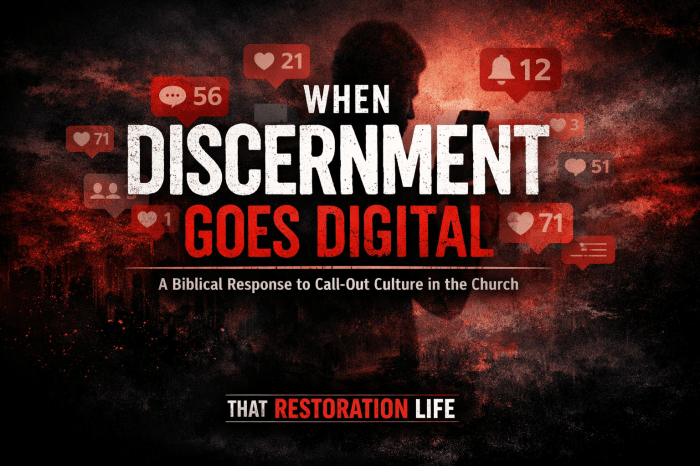
When Discernment Goes Digital

The Age of Instant Rebuke

We are living in a time where correction travels faster than conversation.

A sermon clip goes viral.
A quote is isolated.
A ministry decision is misunderstood.

And within hours—sometimes minutes—followers of Jesus are publicly rebuking other followers of Jesus in front of thousands.

What once required prayer, process, and personal conversation now requires only a phone and a platform.

Some call it discernment.
Others call it boldness.
Still others call it necessary accountability.

But we must ask:

Is this how Scripture teaches us to handle disagreement within the body of Christ?

This series will address three essential questions:

  1. What does the Bible say about correcting fellow believers?
  2. When is public rebuke appropriate—and when is it sinful?
  3. How can we practice discernment without destroying unity?

The goal is not silence.
The goal is not compromise.
The goal is restoration.

Because biblical correction is never about winning arguments—it is about winning brothers and sisters.

Saved by Grace: Understanding the Gift You Never Earned

Have you ever found yourself questioning whether you’re “saved enough”? Maybe you’ve wondered if that one big mistake disqualified you from heaven. Perhaps you’ve caught yourself mentally tallying your good deeds against your failures, hoping the scale tips in your favor. If so, you’re not alone—and you might be missing the most liberating truth in all of Scripture.

The Question That Haunts Us

Many people who’ve walked church aisles, said the prayer, and been baptized still wrestle with a gnawing uncertainty: “Am I still saved?” It’s a question that reveals something profound about human nature—we struggle to accept gifts we haven’t earned.

The reality is that most of us don’t question whether we’re saved. We question whether we’re still saved. Life happens. We mess up. We sin. And suddenly that assurance we once felt begins to erode, replaced by fear that maybe we’ve crossed a line too far.

But here’s the problem: that thinking completely misses what salvation actually is.

What the Bible Actually Says

Ephesians 2:8-10 lays it out with crystal clarity: “For you are saved by grace through faith, and this is not from yourselves, it is God’s gift—not from works so that no one can boast, for we are his workmanship, created in Christ Jesus for good works, which God prepared ahead of time for us to do.”

Let’s break this down, because every word matters.

“You are saved by grace.” Grace is unmerited favor—something you didn’t earn and don’t deserve. It’s the opposite of wages. The only wage the Bible mentions is in Romans 6:23: “The wages of sin is death.” That’s what we earned. But salvation? That’s pure gift.

Think about it this way: the only difference between you and someone sitting in jail right now might be that you didn’t get caught. Did you speed this week? Break any traffic laws? Say something you shouldn’t have? We’re all lawbreakers at some level. We all deserve consequences. But grace means we don’t get what we deserve.

“Through faith.” Faith is the channel through which grace flows. But here’s the critical point—it’s the object of your faith that matters, not the strength of it. You can have tremendous faith in a plastic chair, but if you weigh 500 pounds, that chair is breaking. Conversely, you can have weak, trembling faith in Jesus Christ, and you’re secure.

Your faith must be in Jesus—specifically in His finished work on the cross. Not in the Holy Spirit (who didn’t die for you), not in Mary (who needed salvation herself), not in your church attendance, baptism, or good deeds. Jesus alone.

“This is not from yourselves.” This phrase destroys any notion that your performance plays a role in securing salvation. If grace began your salvation, how could your performance sustain it? If grace started something, it doesn’t matter what you do or don’t do—you can’t maintain it through effort. It’s maintained by a force much greater than you.

The Thief on the Cross

Consider the criminal crucified next to Jesus. He was a “pretty bad dude”—a convicted felon dying for his crimes. In his final moments, he recognized Jesus and asked to be remembered. Jesus responded, “Today you will be with me in paradise.”

Notice what didn’t happen: history didn’t pause so Jesus could climb down, baptize the thief, and climb back up. There was no church membership class, no probationary period, no list of good deeds to complete. Just grace, received through faith, in the final seconds of a wasted life.

If baptism were required for salvation, Jesus lied to that thief. But Jesus doesn’t lie. The thief went to heaven the same way you do—by grace through faith in Christ alone.

The Gift You Can’t Lose

Salvation is described as a gift. What happens when someone gives you a gift and then tries to take it back? You’d be rightfully upset. A gift, by definition, is freely given with no strings attached.

God doesn’t take His gifts back. He’s not a liar. If He gave you salvation freely, He wants you to keep it freely. Your performance after salvation doesn’t determine whether you keep it, because your performance before salvation didn’t earn it.

This doesn’t mean you can live however you want. But it means your security isn’t based on your perfection. If you’ve genuinely been saved, you’ve been transformed. The Bible says you’re a new creation—old things have passed away, all things have become new.

What About Good Works?

“Wait,” you might be thinking, “doesn’t the Bible talk about good works?” Absolutely. But notice the order in Ephesians 2: we’re saved by grace (verse 8), not by works (verse 9), for good works (verse 10).

Good works are the result of salvation, not the requirement for it. You don’t do good things to get saved; you do good things because you are saved.

Think of it like a wedding ring. The ring doesn’t make you married—it simply identifies who you belong to. Similarly, baptism doesn’t save you; it publicly identifies you with Christ. Good deeds don’t earn heaven; they demonstrate that heaven has already transformed you.

You’re God’s workmanship, created for good works that He prepared beforehand. You don’t work for approval; you work from approval. You’re already accepted, already loved, already secure. Now you get to respond in obedience and gratitude.

The Freedom of Grace

When you truly grasp that salvation is entirely by grace, it changes everything. You stop walking around defeated, wondering if you’ve done enough. You stop comparing yourself to others. You stop fearing that one mistake will cost you eternity.

Instead, you wake up each day with the freedom to tell someone about Jesus—not because you have to, but because you get to. You serve not from obligation but from overflow. You obey not to earn God’s love but because you already have it.

This is the life God designed for you: secure in His grace, free from performance anxiety, empowered to do the good works He prepared for you before the world began.

Where Is Your Faith?

So let me ask you: where is your faith today? Is it in your church attendance? Your baptism? Your good deeds? Your family heritage? If so, your faith is misplaced.

Or is your faith in Jesus Christ—in His death, burial, and resurrection? In His finished work on the cross? In His declaration, “It is finished”?

Grace has secured what performance never could. You are saved by grace through faith. It’s a gift. Accept it. Rest in it. And then live from the freedom it provides.

Because the same Jesus who saved you wants to use you to tell others they can have it too.
Who Should Be the Focus—Jesus, the Holy Spirit, the Gifts, or the Father?

In many church settings today, the tension is not whether God is at work, but which expression of God should take center stage.

Some emphasize Jesus.
Some emphasize the Holy Spirit.
Some emphasize the gifts of the Spirit.
Others stress devotion to the Father.

Biblically, this is not a competition. It is a matter of Trinitarian order and theological priority.

The question is not Who matters most?
The question is: What does Scripture reveal about divine focus?

1. The Father’s Plan: The Source of Redemption

The New Testament consistently presents God the Father as the initiator of salvation.

“For God loved the world in this way: He gave his one and only Son…” (John 3:16, CSB)

The Father sends.
The Father chooses.
The Father adopts (Ephesians 1:3–5).

Salvation originates in the will of the Father. He is the architect of redemption. However, Scripture does not present the Father as operating independently of the Son or the Spirit.

The Father’s purpose is clear: to glorify the Son.

2. The Son’s Centrality: Jesus as the Revealed Focus

The New Testament repeatedly centers on Jesus Christ.

Paul writes:

“For I decided to know nothing among you except Jesus Christ and him crucified.” (1 Corinthians 2:2, CSB)

And again:

“God exalted him to the highest place and gave him the name that is above every name.” (Philippians 2:9, CSB)

The preaching of the apostles in Acts of the Apostles was relentlessly Christ-centered.

Not gift-centered.
Not experience-centered.
Not personality-centered.

Christ-centered.

Theologically speaking:

  • The Father sends the Son.
  • The Son accomplishes redemption.
  • The Spirit applies redemption.
  • All glory returns to the Son (John 16:14).

This establishes biblical priority: Jesus is the visible focal point of redemption history.

3. The Holy Spirit’s Role: Not Spotlight, But Floodlight

The Holy Spirit is not minimized in Scripture—but His mission is specific.

Jesus said:

“He will glorify me, because he will take from what is mine and declare it to you.” (John 16:14, CSB)

The Spirit does not draw attention to Himself.
He magnifies Christ.

He convicts (John 16:8).
He regenerates (John 3:5–8).
He indwells (Romans 8:9).
He empowers (Acts 1:8).

But His ministry is Christ-exalting, not self-exalting.

Any movement that shifts primary focus from Christ to spiritual manifestations risks departing from biblical order.

4. The Gifts of the Spirit: Means, Not the Center

The spiritual gifts listed in **First Epistle to the Corinthians 12–14 are given:

  • For edification
  • For unity
  • For mission

Paul corrects the Corinthian church not because they lacked gifts—but because they lacked order and Christ-centered love.

“Pursue love and desire spiritual gifts…” (1 Corinthians 14:1, CSB)

Notice the order: love first, gifts second.

Gifts are instruments.
Jesus is Lord.

If gifts become the primary identity of a church, the church becomes experience-driven rather than gospel-driven.

5. The Biblical Framework: Trinitarian Harmony

Scripture presents a coherent pattern:

  • The Father plans redemption.
  • The Son accomplishes redemption.
  • The Spirit applies redemption.
  • The gifts support the mission of redemption.
  • The church proclaims redemption.

This is not hierarchy of importance—it is order of revelation.

When the early church gathered in Jerusalem, they devoted themselves to:

  • The apostles’ teaching
  • Fellowship
  • Breaking of bread
  • Prayer (Acts 2:42)

And the content of apostolic teaching was Christ crucified and risen.

So What Should Be the Focus?

The biblical answer is clear:

The focus of the church is Jesus Christ.

The Father directs attention to Him.
The Spirit glorifies Him.
The gifts testify to Him.
The gospel proclaims Him.

Colossians 1:18 states:

“He is also the head of the body, the church… so that he might come to have first place in everything.” (CSB)

Not second place.
Not shared place.
First place.

Restoration Truth

When the focus is:

  • Gifts → churches compete.
  • Experiences → people chase manifestations.
  • The Spirit detached from Christ → theology drifts.
  • The Father without the Son → doctrine becomes abstract.

But when the focus is Jesus, everything finds its proper alignment.

A Spirit-filled church will be Christ-exalting.
A Father-honoring church will be Son-centered.
A gift-operating church will be gospel-driven.

Final Word

The Trinity is never divided in Scripture.
But the spotlight of redemption rests on the Son.

The healthiest churches are not those that talk most about gifts.
Nor those that debate theological systems.

They are the ones that, like Paul, resolve to know nothing among the people except Jesus Christ and Him crucified.

Because when Jesus is central—
The Father is honored,
The Spirit is active,
The gifts are ordered,
And the church is restored.