Walking in True Freedom: Breaking the Chains We Place on Ourselves

Have you ever watched someone walk out of prison, only to return voluntarily? It sounds absurd, doesn’t it? Yet spiritually, this is exactly what countless believers do every single day. We’ve been declared free, the cell door stands wide open, but we shuffle back inside because we’ve grown comfortable with the chains.

The truth is staggering: There is no condemnation for those in Christ Jesus. Romans 8:1 doesn’t say “minimal condemnation” or “condemnation on Tuesdays.” It says no condemnation. Zero. None. Yet we walk around as if we’re still awaiting sentencing, still trying to prove ourselves worthy, still attempting to earn what has already been freely given.

The Illusion of Earning Freedom

We’ve been sold a dangerous lie—that salvation is free, but acceptance requires a checklist. Stop smoking. Stop drinking. Clean up your language. Fix your relationships. Then you can approach Jesus. But here’s the revolutionary truth: Jesus knew everything about you before Genesis 1:1, and He still chose to create you. He formed the tree that would become His cross. He created the thorns that would pierce His brow. He made the metal that would nail His hands. And He did it all knowing what it would cost Him.

That’s not conditional love. That’s scandalous, reckless, overwhelming love.

The law of the Spirit of life in Christ Jesus has set us free from the law of sin and death. We’re not striving toward freedom—we’re living from freedom. The difference is everything.

Changing Your Mindset

Romans 8:5-6 draws a stark contrast: “Those who live according to the flesh have their minds set on the things of the flesh, but those who live according to the Spirit have their minds set on the things of the Spirit. Now the mindset of the flesh is death, but the mindset of the Spirit is life and peace.”

The battle isn’t primarily behavioral—it’s mental. We’re called to renew our minds daily, to take thoughts captive, to recognize that we now have the mind of Christ. But here’s the catch: whichever nature we feed will grow the strongest. Feed the flesh, and you’ll walk in fleshly patterns. Feed the Spirit, and you’ll walk in spiritual freedom.

Think about a child being tossed in the air by their father. The child doesn’t panic mid-flight because they trust Dad will catch them. They don’t need to see the landing to know it’s secure. That’s the kind of trust we’re called to—not blind faith, but informed confidence in a Father who has never dropped us and never will.

The Power Within You

Here’s where theology gets uncomfortable for many: If the Spirit of Him who raised Jesus from the dead lives in you, then He who raised Christ from the dead will also bring your mortal bodies to life through His Spirit who lives in you (Romans 8:11).

Read that again slowly. The same power—the exact same power—that resurrected Jesus from death lives inside every believer. Not a lesser version. Not a watered-down edition. The same Spirit.

Jesus performed miracles not primarily because He was God, but because He operated as a man filled with the Holy Spirit. And He said we would do even greater things than He did. Why aren’t we? Because we’re still sitting in unlocked cells, believing we’re prisoners.

Your Job Description

When you accepted Christ, your job description changed permanently. It’s no longer about you. You’ve been commissioned as an ambassador, a seed-planter, a water-bearer. Your role is to share the good news with a lost and dying world.

Statistics tell us that over 150,000 people die every 24 hours worldwide, and if current trends hold, more than 95% die without Christ. That’s 135,000 people every single day stepping into eternity separated from God. Hell wasn’t created for humans—it was prepared for the devil and his fallen angels. Every person who ends up there is a trespasser, someone for whom Christ died but who never accepted His gift.

This isn’t meant to induce guilt but to ignite urgency. We don’t know who will accept Christ and who won’t. Our job isn’t to judge or condemn—it’s to plant seeds, water them, and trust God for the harvest.

Living It Out

About 95% of witnessing isn’t verbal—it’s lived. People watch how you handle turbulence, how you respond to bad news, how you treat servers at restaurants, what you do when life doesn’t go according to plan. They’re watching to see if your faith is real or just another performance.

Consider this: if your dad is flying the plane, you don’t panic during turbulence. You trust the pilot. God is your pilot. He’s never said “oops” or “uh-oh.” He’s never been surprised by your circumstances. He already knew, already planned, already prepared a way through.

Sometimes His “yes” doesn’t look like our yes. Sometimes His rescue doesn’t match our blueprint. But if He’s our Father, we must trust Him—even when the path winds through valleys we’d rather avoid.

Breaking Free From Self-Imposed Chains

The most tragic bondage is the kind we inflict on ourselves. We know the theology of grace, but we live under the tyranny of performance. We preach freedom but practice legalism. We declare victory but walk in defeat.

Stop wallowing in the mud. Pigs wallow; sheep don’t. You’ve been transformed from pig to sheep, from death to life, from condemned to justified. Old things have passed away—all things have become new. Not some things. Not most things. All things.

The enemy’s greatest weapon isn’t temptation—it’s the lie that you’re still defined by your past. He wants you handcuffed by guilt, paralyzed by shame, silenced by unworthiness. But Romans 8 declares otherwise. You’re not condemned. You’re not guilty. You’re not disqualified.

You’re free.

The Call Forward

So what now? Stop checking boxes hoping to earn what’s already yours. Stop trying to be good enough for a God who already declared you righteous. Stop living like a prisoner when the warden Himself unlocked your cell.

Instead, renew your mind. Feed the Spirit. Take thoughts captive. Surround yourself with truth. Read the Word. Worship authentically. Build genuine relationships with other believers. And then—boots on, not flip-flops—wade into the mess of this world as an agent of hope.

Your dad is flying the plane. Trust Him. The landing is secure, even when the turbulence is terrifying. You’re free—truly, completely, eternally free. Now live like it.
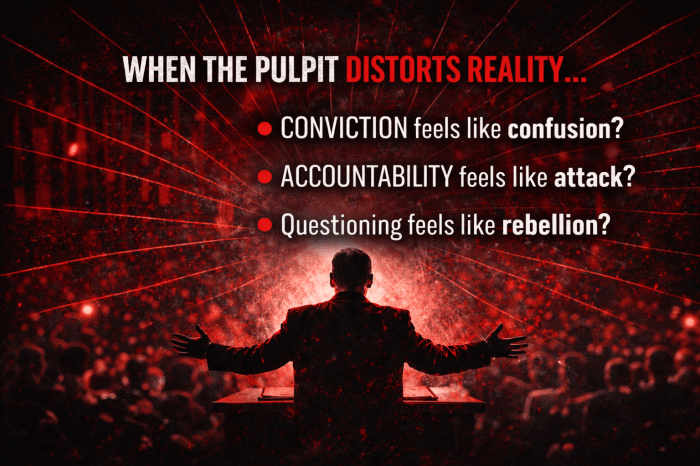

When the Pulpit Distorts Reality Part 3 Confronting, Staying or Leaving

This is the hardest part.

When to Approach Privately

Matthew 18 provides a clear pattern:

“If your brother sins against you, go and tell him his fault between you and him alone.” (Matthew 18:15, CSB)

If safe and appropriate, seek clarification privately:

  • “Help me understand what you meant.”
  • “I’m confused because this was said previously.”

Watch the response.

Humble leaders clarify. Defensive leaders deflect.

When Leadership Rejects Accountability

Ezekiel 34 condemns shepherds who feed themselves instead of the flock.

If leadership consistently:

  • Denies clear statements
  • Shames dissent publicly
  • Claims exclusive access to God’s voice
  • Refuses outside accountability

You must ask whether the environment is spiritually safe.

Leaving Is Not Always Rebellion

Some believers stay too long because they fear being labeled disloyal.

But Christ is the Head of the Church—not any pastor.

If remaining means:

  • Ongoing confusion
  • Emotional manipulation
  • Suppressed conscience
  • Fear-based compliance

Leaving may be an act of stewardship.

Paul left cities when ministry became spiritually toxic. Even Jesus walked away from hardened environments.

Departure is not betrayal when conscience demands it.

A Word to Pastors

James 3:1 warns that teachers will receive stricter judgment.

Authority is not entitlement. It is stewardship.

If you preach, ask:

  • Do I admit mistakes publicly?
  • Do I welcome accountability?
  • Do I distinguish my opinion from Scripture?
  • Do I shepherd or control?

The pulpit must never become a weapon.

Final Encouragement

If you have experienced gaslighting from a pulpit:

  • You are not unstable for asking questions.
  • You are not rebellious for seeking clarity.
  • You are not dishonoring God by pursuing truth.

Healthy churches do not fear examination.
Healthy leaders do not fear accountability.
Healthy preaching does not distort reality.

And restoration begins wherever truth is honored.

When the Pulpit Distorts Reality Part 2 How to Respond Without Losing Your Spiritual Stability

Recognizing gaslighting is step one. Responding biblically is step two.

1. Separate Conviction from Confusion

The Holy Spirit convicts specifically and clearly.

“For God is not a God of disorder but of peace.” (1 Corinthians 14:33, CSB)

Conviction says, “I need to repent.”
Gaslighting says, “Maybe I’m spiritually defective.”

When preaching leaves you doubting your sanity rather than examining your sin, pause and evaluate.

2. Test Everything Against Scripture

The Bereans were commended because:

“They examined the Scriptures daily to see if these things were so.” (Acts 17:11, CSB)

Healthy pastors welcome biblical examination.
Unhealthy pastors fear it.

You are not dishonoring leadership by measuring teaching against Scripture. You are honoring Scripture.

3. Document Patterns

Gaslighting thrives in ambiguity. Write down:

  • What was said
  • When it was said
  • What changed later

Patterns matter more than isolated moments.

4. Seek Outside Counsel

“With many counselors there is deliverance.” (Proverbs 11:14, CSB)

Speak to mature believers outside the leadership structure. Not to gossip—but to gain clarity.

Isolation strengthens manipulation. Community strengthens discernment.

5. Guard Your Heart from Bitterness

Manipulation wounds deeply. But bitterness compounds the damage.

“Pursue peace with everyone, and holiness…” (Hebrews 12:14, CSB)

You can reject manipulation without embracing resentment.

When the Pulpit Distorts Reality Part 1 Recognizing Gaslighting from the Platform

Before you can respond to manipulation, you must be able to identify it.

What Gaslighting Is

Gaslighting is a form of manipulation where someone causes others to question their memory, perception, or spiritual judgment.

In a church setting, it often sounds spiritual.

It may include:

  • Denying statements that were clearly made publicly
  • Reframing disagreement as rebellion
  • Suggesting that questioning leadership equals resisting God
  • Shaming those who leave or raise concerns
  • Claiming divine authority for personal opinions

This is not conviction. It is control.

Biblical Authority vs. Personal Control

Scripture affirms pastoral leadership.

“Obey your leaders and submit to them, since they keep watch over your souls as those who will give an account.” (Hebrews 13:17, CSB)

Notice the phrase: “give an account.”

Biblical authority is accountable. Manipulative authority resists scrutiny.

Paul clarified his own leadership posture:

“We are not lording it over your faith, but are workers with you for your joy.” (2 Corinthians 1:24, CSB)

Gaslighting lords over faith.
Biblical leadership works for joy.

Signs You May Be Experiencing Gaslighting

  1. You frequently leave services confused rather than convicted.
  2. Your legitimate questions are labeled as rebellion.
  3. The pastor redefines past statements and denies clear records.
  4. Public sermons subtly target unnamed individuals who disagree.
  5. The congregation is taught that leaving equals spiritual failure.

Healthy preaching may challenge you.
Gaslighting preaching destabilizes you.

The Fruit Test

Jesus said:

“You’ll recognize them by their fruit.” (Matthew 7:16, CSB)

Ask:

  • Does this leadership produce peace or paranoia?
  • Is humility modeled publicly?
  • Are mistakes acknowledged or denied?

Manipulation cannot produce spiritual maturity. It produces fear-based loyalty.

When the Pulpit Distorts Reality. A Three–Part Series on Handling Preachers Who Gaslight from the Platform

When Spiritual Authority Becomes Spiritual Manipulation

The local church is meant to be a place of clarity, truth, and restoration. The pulpit is not a stage for personality—it is a platform for proclamation. When rightly handled, preaching brings conviction, comfort, correction, and courage.

But sometimes something else happens.

Instead of clarity, there is confusion.
Instead of shepherding, there is shaming.
Instead of Scripture being central, the preacher becomes central.

This series addresses a painful but increasingly common issue: gaslighting from the platform.

Gaslighting is not simply strong preaching. It is not bold conviction. It is not authority exercised biblically. Gaslighting is psychological manipulation wrapped in spiritual language. It causes people to question their perception, doubt legitimate concerns, and feel spiritually inferior for asking honest questions.

This three-part series will examine:

  • Part 1: How to recognize gaslighting in preaching
  • Part 2: How to respond biblically and wisely
  • Part 3: When to stay, when to confront, and when to leave

The goal is not to create suspicion toward pastors. The goal is discernment for believers and accountability for leaders.

Because true restoration can only happen where truth is honored.

Living in the Victory That’s Already Won

There’s a powerful truth that many believers miss as they navigate the challenges of daily life: the war has already been won. We’re not fighting for victory—we’re fighting from victory.

Consider the remarkable story of Hiroo Onoda, a Japanese soldier who emerged from the jungles of the Philippines in 1974, nearly three decades after World War II had ended. For 29 years, he remained in hiding, still believing he was at war, unaware that peace had been declared long ago. He continued his mission, ducking, dodging, and surviving—all unnecessarily.

How many of us live like Onoda? We claim to follow Christ, yet we walk through life as if we’re still trapped in a battle that Jesus already won on the cross. We’re ducking and dodging, weighed down by burdens that were lifted two thousand years ago. Yes, we still have an enemy who prowls around like a roaring lion, but the decisive victory has been secured. We’re not hoping to win; we’re standing on the foundation of a triumph already accomplished.

The Declaration of Righteousness

Romans 5 opens with a transformative word: “Therefore.” This single word signals a shift from everything that came before—the reality of our sin, our brokenness, our inability to save ourselves. But therefore, because of what Christ has done, we have been declared righteous by faith.

Not through our works. Not through our striving. Through faith alone.

This righteousness isn’t something we earn or gradually achieve. It’s a declaration—a legal pronouncement from the throne of heaven. We stand justified before God, which simply means we’ve been made righteous through faith in Jesus Christ.

And because of this declaration, we have peace with God through our Lord Jesus Christ. Not the temporary peace that comes from favorable circumstances, but the deep, unshakable peace that comes from being reconciled to our Creator.

Direct Access to the Father

Here’s a truth that should revolutionize how we approach our spiritual lives: we have obtained direct access to God through Jesus Christ. No intermediary required. No special code. No waiting in line.

Think about what this means practically. The same Holy Spirit that empowers pastors and teachers empowers every believer. You don’t need someone else to pray for you as your only connection to God—you can approach the throne of grace yourself. You can open the Bible and allow the same Spirit who inspired it to teach you directly.

This doesn’t diminish the value of spiritual leadership or community, but it should liberate us from a passive faith that depends entirely on others for our spiritual sustenance. If the only time you connect with God is when you ask someone else to pray for you, something is fundamentally wrong. You have the same access, the same Spirit, the same invitation to come boldly before the throne.

Grace for the Journey

We stand in grace. Not just saved by grace, but standing in it—living in it daily. This grace isn’t just for salvation; it’s for every moment, every challenge, every unexpected blow that life delivers.

When crisis comes—and it will come—believers should respond differently than the world. Not because we’re immune to pain or because we don’t grieve, but because we have a hope that anchors us when everything else is shaking. We have access to supernatural grace that enables us to keep moving forward even when our hearts are breaking.

The problem is that many believers hoard grace rather than walking in it. We hold it close, treating it like a scarce resource rather than an overflowing fountain. But grace is meant to spill out from our lives onto others. When we genuinely walk in the grace we’ve been given, it naturally flows from us to the broken world around us.

The Purpose of Affliction

Romans 5:3-4 presents a perspective that contradicts our natural thinking: “We also rejoice in our afflictions, because we know that affliction produces endurance, endurance produces proven character, and proven character produces hope.”

This doesn’t mean we seek out suffering or pretend it doesn’t hurt. It means we understand that God, in His sovereignty, uses even our most difficult seasons to shape us. When we face trials, endurance is built. As we endure, character is formed. And proven character produces a hope that cannot be shaken.

Today’s culture struggles with this concept because we’ve created a generation that hasn’t had to earn much or struggle for anything. When everything is handed to us, we develop no resilience. When the first real difficulty comes, we crumble because we’ve never built the character muscles necessary to endure.

But God loves us too much to leave us weak and undeveloped. He allows challenges not to harm us but to strengthen us, to prepare us for greater purposes we can’t yet see.

The Foundation of Our Hope

Our hope rests on an unshakable foundation: “God proves his own love for us in that while we were still sinners, Christ died for us” (Romans 5:8).

We weren’t saved because we cleaned ourselves up first. We weren’t reconciled because we finally got our act together. While we were enemies—actively at war with God—Christ died for us. The cross wasn’t a reward for good behavior; it was a rescue mission for rebels.

This truth should fundamentally change how we view ourselves and others. That person you think is too far gone? Christ died for them while they were His enemy. That sin you think is unforgivable? It’s covered by the same blood that covered yours.

We approach life differently when we truly grasp this. We extend grace more freely because we remember how freely it was extended to us. We pursue the lost more passionately because we remember what it cost to find us.

Living as the Reconciled

If we’ve been reconciled to God through Christ’s death, how much more will we be saved by His life? We’re not just forgiven and left to fend for ourselves. We’re empowered by the resurrected life of Jesus working in us through the Holy Spirit.

This means we should live like it. Not perfectly—none of us will achieve that this side of heaven. But differently. Distinctly. The world should be able to look at us and see something that doesn’t make sense apart from the supernatural work of God.

We’re the only Bible many people will ever read. Our lives are living testimonies to the reality of what we claim to believe. When we live in the fullness of our reconciliation—walking in peace, extending grace, enduring with hope—we become walking billboards for the transforming power of the gospel.

The war is over. Victory is secured. Now it’s time to live like we believe it.

PART 3 Discernment Without Division

How to Engage Disagreement the Right Way

The church needs discernment.

But discernment without love becomes suspicion.
And discernment without humility becomes arrogance.

The Witness of Unity

Jesus prayed:

“May they all be one… so that the world may believe you sent me.”
— John 17:21 (CSB)

Our unity is tied to our witness.

When believers publicly devour one another, the watching world does not see doctrinal integrity—it sees division.

Paul warned:

“But if you bite and devour one another, watch out, or you will be consumed by one another.”
— Galatians 5:15 (CSB)

Social media has amplified the bite.

Practical Guidelines Before Posting

Before publicly calling out another ministry:

  1. Have I contacted them privately?
  2. Do I fully understand their teaching in context?
  3. Is this a primary gospel issue?
  4. Am I speaking from grief or from irritation?
  5. Would I say this the same way face-to-face?

If the answer reveals pride more than love, silence may be the holier option.

Sometimes the Most Spiritual Thing Is Restraint

Proverbs reminds us:

“The one who guards his mouth protects his life.”
— Proverbs 13:3 (CSB)

Not every disagreement requires a microphone.

Not every concern requires a post.

Maturity often looks like measured silence.

Restoration Over Reputation

Correction should always be governed by 1 Corinthians 13:

“Love is patient, love is kind… it is not arrogant, is not rude, is not self-seeking.”
— 1 Corinthians 13:4–5 (CSB)

If our correction lacks love, it lacks legitimacy.

The church does not need more digital prosecutors.

It needs shepherds.

It needs maturity.

It needs believers who can discern truth without destroying unity.

There is a difference between contending for the faith and competing for attention.

May our correction reflect Christ.
May our disagreement be charitable.
And may restoration remain the goal.

PART 2 When Public Rebuke Is Biblical

Guarding the Gospel Without Guarding Ego

We must be balanced.

The Bible does not forbid public rebuke in every circumstance.

Paul publicly confronted Peter:

“But when Cephas came to Antioch, I opposed him to his face because he stood condemned.”
— Galatians 2:11 (CSB)

Why?

Because the gospel itself was being compromised.

Peter’s behavior threatened the truth that salvation is by grace, not by ethnic boundary or law-keeping.

This was not a stylistic disagreement.
It was a gospel issue.

The Standard for Public Correction

Public correction in Scripture typically occurs when:

  1. The gospel is distorted.
  2. False doctrine is being widely spread.
  3. Harm to the church is ongoing and unrepentant.

Paul warns Titus:

“Reject a divisive person after a first and second warning.”
— Titus 3:10 (CSB)

Notice again—process precedes exposure.

Warnings first.
Opportunity for repentance first.

The Danger of Elevating Secondary Issues

Many online controversies are not gospel-denying errors.
They are interpretive differences.

Paul instructs believers:

“Accept anyone who is weak in faith, but don’t argue about disputed matters.”
— Romans 14:1 (CSB)

Not every theological difference is heresy.

There is a category in Scripture for disputable matters.

Confusing preference with apostasy is spiritually immature—and socially destructive.

Check the Motive

James provides sobering clarity:

“For where there is envy and selfish ambition, there is disorder and every evil practice.”
— James 3:16 (CSB)

Some public rebukes are fueled less by love for truth and more by love for platform.

Before speaking publicly, we must ask:

Am I protecting people—or building influence?

PART 1The Biblical Pattern for Correction

Private Before Public

One of the most alarming trends in the modern church is skipping the process Jesus clearly gave us.

We have replaced conversation with commentary.

But Jesus was explicit:

“If your brother sins against you, go and rebuke him in private. If he listens to you, you have won your brother.”
— Matthew 18:15 (CSB)

Notice the order.

Private first.
Relational first.
Redemptive first.

The purpose is not exposure.
The purpose is restoration.

The Goal Is Winning, Not Wounding

Jesus said, “you have won your brother.”

Correction in Scripture is restorative in intent. The aim is not humiliation but reconciliation.

Paul echoes this in Galatians:

“If anyone is overtaken in any wrongdoing, you who are spiritual, restore such a person with a gentle spirit, watching out for yourselves so that you also won’t be tempted.”
— Galatians 6:1 (CSB)

Three requirements appear here:

  • Spiritual maturity
  • Gentleness
  • Self-awareness

Social media rarely produces those three.

The Wisdom of Slowness

Digital culture rewards immediacy.
Scripture commands restraint.

“Everyone should be quick to listen, slow to speak, and slow to anger.”
— James 1:19 (CSB)

Public call-outs are often quick to speak and quick to anger.

But biblical correction moves slowly, carefully, and relationally.

The Restoration Lens

If correction does not aim at restoration, it is not biblical correction.

At its core, this issue is not about whether correction is allowed.

It is about whether correction reflects Christ.

And Christ corrects with truth and grace—not spectacle.

When Discernment Goes Digital

The Age of Instant Rebuke

We are living in a time where correction travels faster than conversation.

A sermon clip goes viral.
A quote is isolated.
A ministry decision is misunderstood.

And within hours—sometimes minutes—followers of Jesus are publicly rebuking other followers of Jesus in front of thousands.

What once required prayer, process, and personal conversation now requires only a phone and a platform.

Some call it discernment.
Others call it boldness.
Still others call it necessary accountability.

But we must ask:

Is this how Scripture teaches us to handle disagreement within the body of Christ?

This series will address three essential questions:

  1. What does the Bible say about correcting fellow believers?
  2. When is public rebuke appropriate—and when is it sinful?
  3. How can we practice discernment without destroying unity?

The goal is not silence.
The goal is not compromise.
The goal is restoration.

Because biblical correction is never about winning arguments—it is about winning brothers and sisters.