Part Four: The Truth That Sets Us Free
God’s truth does not trap us; it leads us into freedom.
Today, many people see truth as something that holds them back. They view biblical commands as limits on personal freedom and think of obedience as something negative. We often hear that true freedom means having no boundaries, ignoring outside authority, and doing whatever feels right.
Jesus offers a very different view of freedom.
The Bible teaches that freedom is not just doing whatever we want. Real freedom means being set free from the power of sin so we can become who God made us to be. God’s truth does not trap us; it opens the way to real life.
Freedom Begins with Continuing in God’s Word
Jesus said in John 8:31–32:
“If you continue in my word, you really are my disciples. You will know the truth, and the truth will set you free.”
People often quote this promise without mentioning the condition that comes first. Jesus linked freedom to staying in His Word.
Truth does not set us free just because we have heard it. We find freedom when we believe the truth, stick with it, and let it shape our lives. Being a disciple is more than liking what Jesus said; it means following His words.
Jesus continued in John 8:34:
“Truly I tell you, everyone who commits sin is a slave of sin.”
Our culture says freedom means having no limits. But Jesus teaches that someone can look free on the outside but still be trapped inside. Sin promises independence but ends up taking over. What starts as a choice can turn into a habit, and that habit can become a trap.
Jesus does not show us our struggles to judge us. He does it so He can set us free.
God’s Boundaries Are an Expression of His Love
Think of a child playing close to a busy road. A caring parent sets a boundary because they know it’s dangerous. The child might see the boundary as limiting, but it’s really there to keep them safe.
God sees things we cannot. He knows where every path leads. His commands are not random rules meant to make us unhappy. They come from His holy character, perfect wisdom, and love for us.
First John 5:3 says:
“For this is what love for God is: to keep his commands. And his commands are not a burden.”
God’s commands might challenge what we want, but they are never meant to harm us. They protect us from the results of sin and lead us toward the life we were made for.
A fish may view the boundaries of water as limiting, but removing the fish from those boundaries does not create freedom. It produces death. In the same way, we flourish when we live according to the truth and design of our Creator.
Truth Exposes What Is Destroying Us
Hebrews 4:12 says:
“For the word of God is living and effective and sharper than any double-edged sword, penetrating as far as the separation of soul and spirit, joints and marrow. It can judge the thoughts and intentions of the heart.”
God’s Word goes deeper than what we show on the outside. It reveals our motives, uncovers lies, and shows where sin has taken hold.
That can be uncomfortable.
Sometimes we avoid reading the Bible because we do not want to face hard truths. But just as a doctor cannot treat an illness that stays hidden, God shows us what is wrong so we can start to heal.
Feeling convicted is not the same as feeling condemned. Condemnation says, “You are hopeless, and there is no way back.” Conviction says, “This is destroying you, but Jesus is calling you home.”
God tells us the truth about ourselves because He wants to restore us.
Grace Does Not Eliminate Truth
Some think grace means God ignores sin and lets us stay the same. But real grace does more than forgive us—it teaches us to live in a new way.
Titus 2:11–12 says:
“For the grace of God has appeared, bringing salvation for all people, instructing us to deny godlessness and worldly lusts and to live in a sensible, righteous, and godly way in the present age.”
Grace does not give us permission to change what sin means. Instead, grace is God’s power to save us from sin.
Jesus showed this balance when religious leaders brought Him a woman caught in adultery. He did not condemn her, but He also did not say her sin was okay.
John 8:11 records His words:
“‘Neither do I condemn you,’ said Jesus. ‘Go, and from now on do not sin anymore.’”Jesus gave her grace without lowering the standard. He protected her dignity, showed her mercy, and invited her to live differently.e.
Truth shows us we need to change, and grace gives us the power to do it.
Transformation Requires a Renewed Mind
Romans 12:2 says:
“Do not be conformed to this age, but be transformed by the renewing of your mind, so that you may discern what the good, pleasing, and perfect will of God is.”
Culture is always trying to shape how we think. Through things like entertainment, school, ads, politics, and social media, we get constant messages about who we are, what is right, and what makes us happy.
If we do not make a habit of renewing our minds with Scripture, we will slowly start to think like everyone else around us.
We are changed when God’s truth takes the place of the lies we have believed. We learn that our mistakes, feelings, things we own, or what others think do not define us. Our true identity is in Christ.
We find out that being holy does not take away our happiness. Obeying God does not take away our freedom. Giving our lives to Him is not losing life; in Christ, it is where real life starts.
Truth Leads Us to Jesus
The main goal of truth is not just to make us behave better. Truth leads us to Jesus.
John 1:14 says:
“The Word became flesh and dwelt among us. We observed his glory, the glory as the one and only Son from the Father, full of grace and truth.”
Jesus does not wait for us to fix ourselves before we come to Him. He invites us to come as we are, admit our sin, accept His forgiveness, and follow Him.
The truth is that we have all sinned. The truth is that sin separates us from God. But the truth is also that Jesus died for sinners, rose from the dead, and offers forgiveness to everyone who turns to Him in faith.
This is not a message that holds us down. It is the greatest message of freedom the world has ever known.
Our Calling in a Changing Culture
We cannot control what happens in culture, but we can choose where we stand. We can build our lives on feelings and what is popular, or we can stand on God’s unchanging Word.We are called to accept the truth with humility, obey it faithfully, speak it with love, and live it out every day. We should avoid both compromise and harshness. We do not have to pick between truth and love, because Jesus shows us both together.
Culture will keep changing, but God stays the same. His character does not change. His Word will always stand. His promises will never end. His truth will always have power.
Personal Reflection
Ask yourself:
- Am I continuing in God’s Word or merely agreeing with selected parts?
- Have I mistaken the absence of boundaries for genuine freedom?
- What lie does God’s truth need to replace in my thinking?
- Is God exposing an area of bondage that I need to surrender?
- Have I received the grace and freedom Jesus offers?
- Am I living in a way that shows others the goodness of God’s truth?
We do not have to be afraid of the truth. We should let it lead us to the One who forgives, restores, changes us, and sets us free.
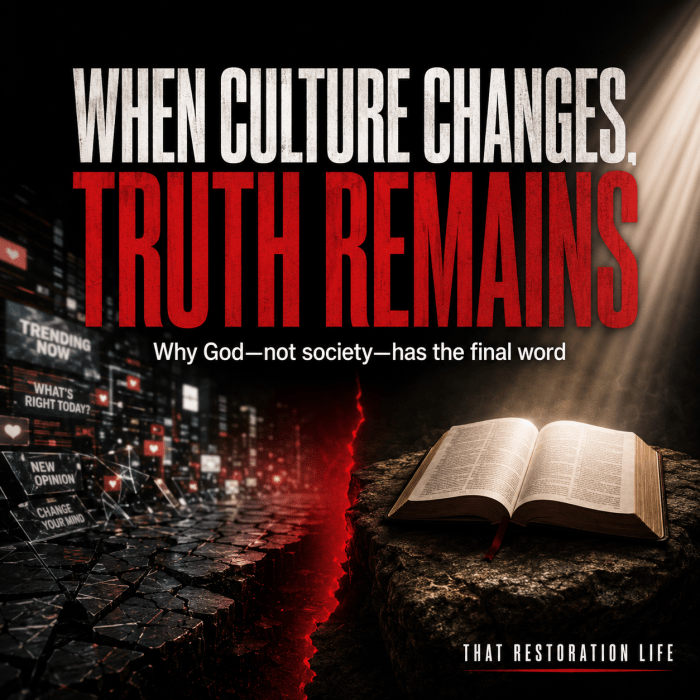
Culture might change its values. Society might change its standards. Public opinion might shift with each generation. But God has spoken, Jesus is still Lord, and when culture changes, truth stays the same.