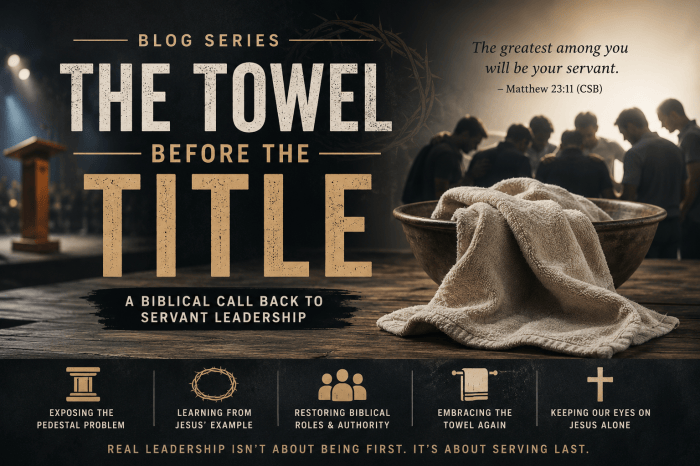
Part 1: When the Title Becomes the Identity
Ministry, Honor, and Status in the Church
There is nothing inherently wrong with calling someone “Pastor.”
It’s not inherently spiritual either.
That distinction matters.
Somewhere along the way, parts of the Church began treating titles as evidence of spiritual authority. Pastor. Bishop. Apostle. Prophet. Reverend. Doctor. Overseer. Elder.
Sometimes the title identifies someone’s responsibility. Other times, however, the title begins communicating rank.
Occasionally, the title becomes more important to the person carrying it than the ministry it is supposed to represent.
That is where we have a problem.
The New Testament absolutely recognizes leadership. It recognizes apostles, prophets, evangelists, pastors, and teachers. It speaks of elders, overseers, and deacons. Scripture commands believers to recognize godly leadership and to honor those who faithfully labor among God’s people.
So the biblical answer is not:
“Titles are bad.”
The better question is:
What place should titles have in the Body of Christ?
Because there is a significant difference between a title that describes your service and a title that defines your significance.
Jesus Had Something to Say About Religious Titles
One of the strongest passages concerning religious recognition comes from Jesus Himself.
In Matthew 23, Jesus confronted the scribes and Pharisees.
His criticism was not simply about what they believed. He exposed something happening in their hearts.
Jesus said:
“They do everything to be seen by others: They enlarge their phylacteries and lengthen their tassels. They love the place of honor at banquets, the front seats in the synagogues, greetings in the marketplaces, and to be called ‘Rabbi’ by people.”
Matthew 23:5–7 CSB
Notice the progression.
They wanted to be seen.
They wanted places of honor.
They wanted public recognition.
They wanted people to acknowledge their position.
The problem wasn’t merely the word Rabbi.
The problem was what the title had come to represent.
Their identity had become attached to recognition.
Jesus was exposing religious pride.
That same temptation still exists.
We can change the terminology while keeping the same heart.
Instead of “Rabbi,” it can become:
“Pastor.”
“Bishop.”
“Prophet.”
“Apostle.”
“Reverend.”
“Doctor.”
The vocabulary changes.
The temptation doesn’t.
Would You Still Serve Without the Title?
Here is one of the most revealing questions any ministry leader can ask:
If nobody ever called me by my title again, would I still do what God called me to do?
Would you still preach?
Would you still pray?
Would you still visit the hospital?
Would you still disciple people?
Would you still counsel struggling marriages?
Would you still serve the forgotten?
Would you still clean the church?
Would you still feed people?
Would you still share the Gospel?
Would you still shepherd people if nobody called you “Pastor”?
Would you still prophesy if nobody called you “Prophet”?
Would you still equip and establish ministries if nobody introduced you as “Apostle”?
Because if the calling disappears when the title disappears, we need to ask whether we were serving the calling or serving the identity the title gave us.
Jesus never taught His disciples to pursue religious status.
He taught them to serve.
Jesus Turned the Leadership Pyramid Upside Down
The disciples themselves struggled with status.
James and John wanted prominent positions in Jesus’ kingdom.
The other disciples became angry, but Jesus used the situation to explain how Kingdom leadership works.
“You know that those who are regarded as rulers of the Gentiles lord it over them, and those in high positions act as tyrants over them. But it is not so among you. On the contrary, whoever wants to become great among you will be your servant, and whoever wants to be first among you will be a slave to all.”
Mark 10:42–44 CSB
Then Jesus gave Himself as the example:
“For even the Son of Man did not come to be served, but to serve, and to give his life as a ransom for many.”
Mark 10:45 CSB
That completely changes our understanding of ministry leadership.
In the world, authority often means:
People serve me.
In the Kingdom, authority means:
I have greater responsibility to serve them.
The higher the responsibility, the more willing we should be to bend.
Jesus demonstrated this dramatically when He washed His disciples’ feet.
The King knelt.
The Lord became the servant.
The One possessing all authority picked up the towel.
That is biblical leadership.
The New Testament Recognizes Roles
We also have to avoid swinging the pendulum too far.
Some people read Jesus’ warnings about titles and conclude that recognizing ministry offices is somehow unbiblical.
Scripture doesn’t support that conclusion.
Paul writes:
“And he himself gave some to be apostles, some prophets, some evangelists, some pastors and teachers, equipping the saints for the work of ministry, to build up the body of Christ.”
Ephesians 4:11–12 CSB
These ministries are real.
But notice their purpose.
They weren’t given so certain Christians could become spiritually important.
They were given for equipping the saints.
The gift isn’t primarily about the person carrying it.
The gift exists for the Body.
A pastor exists to shepherd people.
A teacher exists to teach people.
An evangelist exists to proclaim the Gospel and equip others in Gospel ministry.
A prophet serves God’s purposes in the Body.
An apostolic ministry serves the mission and establishment of Christ’s Church.
Whatever our understanding of these ministries, Ephesians tells us their direction:
Toward the Body, not toward the ego.
A Title Cannot Produce Authority.
This is especially important in modern ministry culture.
Putting “Pastor” before your name doesn’t make you a shepherd.
Putting “Prophet” before your name doesn’t make you prophetic.
Putting “Apostle” before your name doesn’t make you apostolic.
Putting “Bishop” before your name doesn’t automatically make you an overseer.
Putting “Dr.” before your name may represent legitimate academic achievement, but it doesn’t automatically make someone spiritually mature.
A title can identify something.
It cannot create it.
You can print a thousand business cards saying “Pastor,” but eventually the sheep will know whether you shepherd them.
Fruit reveals ministry.
Character reveals maturity.
Service reveals the heart.
Jesus said:
“You’ll recognize them by their fruit.”
Matthew 7:16 CSB
Not their title.
Not their platform.
Not their social media following.
Not their introduction.
Their fruit.
When Correction Becomes an Alarm Bell
One thing that should concern us is when someone becomes deeply offended because another person failed to use their title.
Imagine someone saying:
“You will address me as Apostle.”
“It’s Bishop, not Pastor.”
“Don’t call me by my first name. I’m Prophet ______.”
“You need to address me as Doctor.”
Cultural and professional contexts may call for titles that communicate respect. Courtesy isn’t sinful.
But when recognition becomes a demand, we should examine what is happening in the heart.
Jesus said:
“The greatest among you will be your servant. Whoever exalts himself will be humbled, and whoever humbles himself will be exalted.”
Matthew 23:11–12 CSB
Kingdom authority doesn’t need constant verbal reinforcement.
A shepherd doesn’t become a shepherd because everyone remembers to call him Pastor.
He shepherds because God called him to do it.
Honor Is Still Biblical
This conversation must not become an excuse for dishonoring spiritual leadership.
Scripture says:
“Now we ask you, brothers and sisters, to give recognition to those who labor among you and lead you in the Lord and admonish you, and to regard them very highly in love because of their work.”
1 Thessalonians 5:12–13 CSB
Notice why they are honored:
Because of their work.
Biblical honor recognizes faithful service.
Celebrity culture elevates personalities.
Those are not the same thing.
We should honor faithful pastors.
We should appreciate elders.
We should recognize those who teach us the Word.
We should respect godly leaders.
But biblical leaders should never need the Church to inflate their importance.
Honor should be given freely, not demanded forcefully.
Your Greatest Identity Isn’t Your Ministry
This may be the most important point.
Before you are a pastor, you are a follower of Jesus.
Before you are an apostle, prophet, evangelist, teacher, bishop, elder, deacon, missionary, worship leader, or ministry director, you belong to Christ.
Your deepest identity isn’t your assignment.
Your identity is found in Jesus.
Ministry can change.
Positions can change.
Churches can change.
Assignments can end.
Platforms can disappear.
Titles can be removed.
But your identity in Christ remains.
Paul wrote:
“If anyone is in Christ, he is a new creation; the old has passed away, and see, the new has come!”
2 Corinthians 5:17 CSB
That’s an identity worth holding tightly.
The Towel Matters More Than the Title
There is nothing necessarily wrong with someone calling you Pastor.
There is nothing necessarily wrong with recognizing someone as an elder, bishop, evangelist, prophet, teacher, or apostle when those descriptions accurately reflect biblical ministry.
The danger begins when we need the title.
When we crave it.
When we demand it.
When we measure our importance by it.
When we believe it places us above other believers.
When losing the title feels like losing our identity.
Jesus offers us something better than religious status.
He gives us a towel.
And perhaps one of the healthiest questions any leader can regularly ask is:
Am I more concerned about what people call me or whether I am faithfully doing what Jesus called me to do?
Because at the end of our lives, Jesus isn’t going to be impressed by what was printed before our names.
What matters is whether we faithfully followed Him.
Let the title describe the service.
Never let the title replace the servant.
Coming Next: Part 2
“Call No Man Father”: What Did Jesus Actually Mean?
We will walk carefully through Matthew 23 and examine Jesus’ statements about Rabbi, teacher, father, religious recognition, and spiritual authority.
Because before we build a doctrine around one sentence, we need to hear that sentence in the context in which Jesus actually spoke it.
 Thoughts from Pastor Toney