
Drive-Thru Christianity From Ashes in a Hurry to 15-Minute Sermons

There was a time when gathering with the church meant lingering. Praying. Confessing. Waiting. Listening. Repenting. Worshiping.

Now, in many places, Christianity has become streamlined, optimized, and scheduled to fit between errands.

We have drive-thru ashes.
We have 15-minute sermons.
We have worship sets timed to the second.
We have faith packaged for convenience.

The question isn’t whether methods change. They always have.
The question is whether we have quietly discipled people into casual Christianity—a faith that is efficient but not transformative.

When Convenience Becomes the Goal

In a culture built on speed, everything is optimized:

  • Drive-thru coffee
  • One-click purchases
  • Same-day delivery
  • 30-second videos

The church has not been immune to that pressure.

Some congregations now offer “ashes-to-go” on Ash Wednesday—a sacred symbol of repentance delivered between traffic lights. The intention may be outreach. The heart may be sincere. But the symbolism is striking.

Ashes represent mortality and repentance:

“For you are dust, and you will return to dust.” (Genesis 3:19)

Repentance is not transactional. It is transformational. It is not a ritual to receive—it is a posture to embrace.

When sacred moments become hurried moments, something shifts.

The 15-Minute Sermon Culture

Short sermons are not inherently wrong. Clarity is a virtue. Precision is powerful.

But when preaching is shortened because attention spans have shortened, we should pause.

Paul told Timothy:

“Preach the word; be ready in season and out of season; correct, rebuke, and encourage with great patience and teaching.” (2 Timothy 4:2)

Notice the words:
Correct. Rebuke. Encourage. Patience. Teaching.

That requires time.
That requires weight.
That requires depth.

The early church in Acts of the Apostles “devoted themselves” to teaching (Acts 2:42). Devotion is not casual. Devotion is not rushed.

A 15-minute sermon may inspire.
But sustained exposition transforms.

When We Design Church for Comfort

The danger isn’t brevity. The danger is consumerism.

When church becomes something to attend rather than a body to belong to, the metrics subtly change:

  • Was it engaging?
  • Was it short enough?
  • Did it meet my preferences?

Instead of:

  • Did I repent?
  • Did I grow?
  • Did I obey?

Jesus never marketed convenience.

In Luke 9:23 He said:

“If anyone wants to follow after me, let him deny himself, take up his cross daily, and follow me.”

There is nothing drive-thru about taking up a cross.

The Illusion of Efficiency

Efficiency is excellent for business.
It is dangerous for discipleship.

You can mass-produce content.
You cannot mass-produce maturity.

Formation requires:

  • Time in Scripture
  • Time in prayer
  • Time in community
  • Time in suffering
  • Time in obedience

Spiritual depth grows slowly. The kingdom of God is compared to seeds, leaven, vineyards—organic processes that cannot be microwaved.

Casual Christianity vs. Costly Discipleship

Casual Christianity says:

“Add Jesus to your life.”

Costly discipleship says:

“Lose your life to find it.” (Matthew 16:25)

Casual Christianity is interested in attendance.
Costly discipleship is interested in allegiance.

Casual Christianity wants inspiration.
Costly discipleship demands transformation.

Jesus did not say, “Fit me into your schedule.”
He said, “Follow me.”

Why This Matters

A casual faith cannot withstand cultural pressure.

When storms come—moral confusion, persecution, suffering—shallow roots are exposed.

In Matthew 7:26–27, Jesus described the house built on sand. It looked fine—until the storm hit.

Drive-thru ashes may look spiritual.
15-minute sermons may feel efficient.
Polished services may feel successful.

But depth is revealed under pressure.

A Call Back to Devotion

This is not a call to longer services for the sake of length.
It is a call to restored seriousness.

We need:

  • Preaching that confronts and comforts
  • Worship that is reverent and joyful
  • Churches that disciple, not just gather
  • Believers who linger in prayer
  • Leaders who prioritize formation over production

The early church did not grow because it was convenient.
It grew because it was surrendered.

Final Thought

The gospel is not fast food.
It is daily bread.

You cannot microwave sanctification.
You must walk it out.

Christianity was never meant to be drive-thru.

It was meant to be cross-carrying, Spirit-formed, Scripture-anchored devotion.

The question is not, “How short can we make it?”
The question is, “How deep are we willing to go?”

Why We Rejoice Anyway: The Heart Issues Behind Gloating

Let’s be honest: rejoicing doesn’t come from righteousness.
It comes from unresolved wounds.

Common Root Causes

Believers rejoice when:

  • They felt overlooked
  • They were personally hurt
  • They carried bitterness
  • They struggled with envy
  • They wanted validation

None of these are healed by someone else’s failure.

A Scriptural Warning

Galatians 6:1 (CSB)

“…restore such a person with a gentle spirit, watching out for yourselves…”

The warning is clear:
How you respond to someone else’s sin reveals your own vulnerability.

A Sobering Truth

Celebration today can become temptation tomorrow.

No one is immune.
No one is above falling.
Grace should humble us—not harden us.

If someone else’s fall brings you joy, God may be inviting you to healing, not commentary.

The Way of Jesus: Grief, Truth, and Restoration

Jesus shows us the way.

Not theory.
Not reaction.
But response.

The Jesus Model

  • Peter denied Him → Jesus restored him
  • Judas betrayed Him → Jesus was deeply troubled
  • The woman caught in sin → Jesus confronted and forgave

Christ never celebrated collapse.
He confronted sin and pursued redemption.

What This Looks Like Today

A Christ-centered response includes:

  • Truth without cruelty
  • Accountability without humiliation
  • Justice without gloating
  • Hope without denial

A Call to the Church

We must be a people who:

  • Guard our hearts
  • Watch our words
  • Refuse spectacle
  • Choose restoration

Final Reflection

The Church does not need louder opinions.
It needs deeper maturity.

When ministry falls, the world watches.
Let them see Jesus—not our appetite for downfall.

Discernment vs. Delight: Exposing Sin Without Enjoying It

There is a dangerous confusion in the Church today:
We mistake exposure for enjoyment.

Calling out sin is biblical.
Delighting in someone’s downfall is not.

What Scripture Actually Says

Ephesians 5:11 (CSB)

“Don’t participate in the fruitless works of darkness, but instead expose them.”

Exposure is commanded.
Enjoyment is condemned.

1 Corinthians 13:6 (CSB)

“Love finds no joy in unrighteousness…”

If love cannot rejoice in evil, neither should believers.

The Subtle Shift

Discernment becomes delight when:

  • We linger on details unnecessarily
  • We share information to feel superior
  • We say “this needs to be known” but secretly enjoy saying it

A Necessary Distinction

You can believe:

  • A leader must step down
  • Accountability is required
  • Consequences are appropriate

Without:

  • Mockery
  • Gloating
  • Public satisfaction

Truth spoken without love becomes cruelty.
Love without truth becomes compromise.
The gospel demands both.

The Body Suffers Together: Why Ministry Failure Is Never Entertainment

The Church is not an audience.
It is a body.

And bodies don’t celebrate injury.

A Biblical Framework

1 Corinthians 12:26 (CSB)

“So if one member suffers, all the members suffer with it…”

When a leader falls:

  • Trust is shaken
  • Faith is tested
  • People are hurt
  • The witness of the Church is damaged

This is not content—it is consequence.

Why Public Gloating Is So Destructive

Celebration:

  • Normalizes cruelty
  • Teaches immature believers the wrong response
  • Turns pain into spectacle

The Church becomes indistinguishable from the world when it consumes failure as entertainment.

A Healthier Response

A healthy body responds with:

  • Protection for the vulnerable
  • Prayer for repentance
  • Care for the wounded
  • Wise leadership decisions

Closing Reflection

If we don’t feel the pain of the body, we have misunderstood the Body.


PART 4 — Why We Rejoice Anyway: The Heart Issues Behind Gloating

Opening Thought

Let’s be honest: rejoicing doesn’t come from righteousness.
It comes from unresolved wounds.

Common Root Causes

Believers rejoice when:

  • They felt overlooked
  • They were personally hurt
  • They carried bitterness
  • They struggled with envy
  • They wanted validation

None of these are healed by someone else’s failure.

A Scriptural Warning

Galatians 6:1 (CSB)

“…restore such a person with a gentle spirit, watching out for yourselves…”

The warning is clear:
How you respond to someone else’s sin reveals your own vulnerability.

A Sobering Truth

Celebration today can become temptation tomorrow.

No one is immune.
No one is above falling.
Grace should humble us—not harden us.

If someone else’s fall brings you joy, God may be inviting you to healing, not commentary.

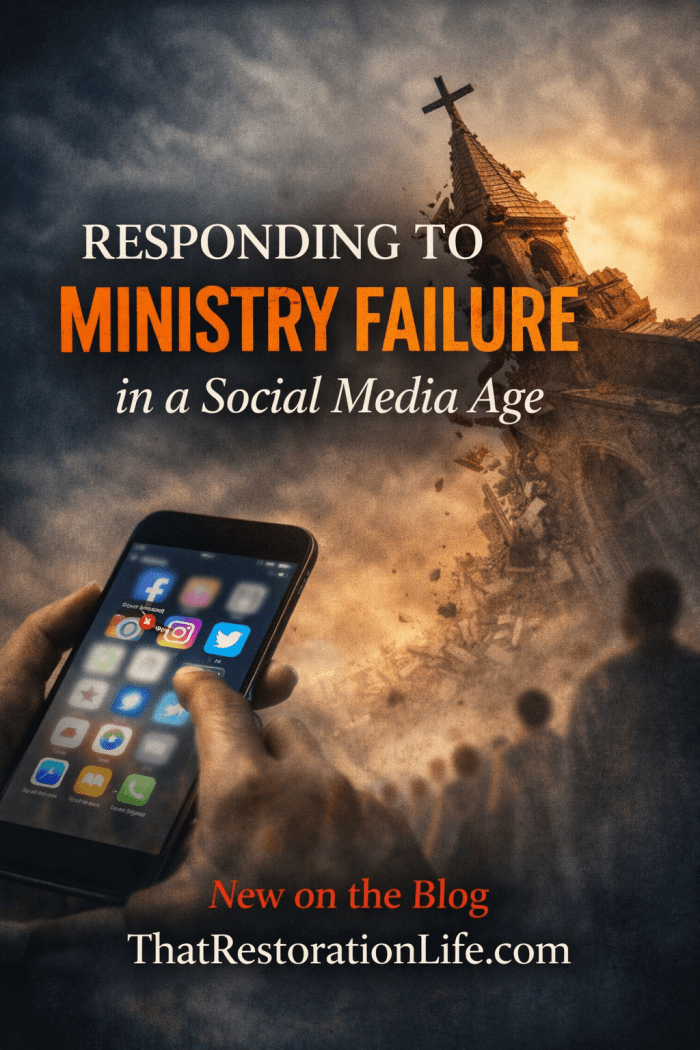
Responding to Ministry Failure in a Social Media Age

A Sober Pattern We Can’t Ignore

It feels relentless.

Every time you open Facebook, scroll Instagram, or glance at a headline, there’s another name.
Another ministry.
Another leader who has fallen.

What once felt occasional now feels constant. The failures are no longer shocking—they’re expected. The question isn’t ifanother story will surface, but when.

And with every new revelation, the Church responds in real time:

  • Posts are shared within minutes
  • Opinions are formed before facts are settled
  • Commentary replaces prayer
  • And too often, grief is replaced by satisfaction

The speed of social media has turned ministry failure into a public event, and in that environment, it’s easy to slip from discernment into delight—without even realizing it.

This series is not written to excuse sin, protect platforms, or minimize harm.
It is written to confront a deeper issue: how followers of Jesus respond when failure becomes frequent and public.

Because Scripture does not change when culture accelerates.

The fall of a minister should sober us, not entertain us.
It should lead us to humility, not headlines.
It should call the Church to maturity, not mockery.

Before we comment, repost, or celebrate, we must ask a harder question:
Are we responding like Christ—or like consumers of collapse?

That question frames everything that follows.

PART 1 — When a Leader Falls: Why Celebration Is the Wrong Response

Every time a ministry leader falls, the Church faces a test—not of doctrine, but of heart posture.

Too often, the response is not grief but celebration.
Not prayer, but posts.
Not restoration, but relief.

Scripture calls us to something better.

The Bible’s Clear Warning

Proverbs 24:17–18 (CSB)

“Don’t gloat when your enemy falls, and don’t let your heart rejoice when he stumbles…”

If Scripture forbids rejoicing over an enemy’s failure, how could celebrating a brother or sister’s fall ever be justified?

Why This Matters

A fallen leader is not proof that “we were right.”
It is evidence that the Church is wounded.

When we celebrate collapse, we reveal:

  • Pride instead of humility
  • Bitterness instead of healing
  • Distance from the heart of Christ

A Heart Check

Ask honestly:

  • Am I grieving or enjoying this?
  • Am I praying or reposting?
  • Am I concerned about restoration—or reputation?

Followers of Jesus are not called to clap at collapse.
We are called to mourn sin, protect people, and pursue restoration.

UNFILTERED — A 3-Part Blog Series. Part 3 — Reading Scripture Unfiltered

Letting the Holy Spirit Interpret Again

It is possible to read the Bible faithfully—and still miss God.

When Scripture is read without the Holy Spirit, it may inform the mind but never transform the heart.

Paul explains:

“The person without the Spirit does not receive what comes from God’s Spirit.”
— 1 Corinthians 2:14 (CSB)

Letting the Bible Read Us

Spiritual maturity begins when we stop asking,
“How does this verse support what I already think?”
and start asking,
“Lord, what are You showing me?”

“For the word of God is living and effective.”
— Hebrews 4:12 (CSB)

Scripture was never meant to be a weapon or a wall.
It was meant to be a mirror and a doorway.

Reading With New Eyes

Reading unfiltered doesn’t mean abandoning theology, teachers, or tradition. It means submitting all of it to God’s truth and the leading of the Holy Spirit.

It looks like:

  • praying before reading
  • listening more than proving
  • obeying before fully understanding

David prayed:

“Open my eyes so that I may contemplate wondrous things from your instruction.”
— Psalm 119:18 (CSB)

That prayer still works.

A Call to Restoration

At That Restoration Life, we believe restoration begins when Scripture is no longer filtered through fear, pride, or inherited assumptions—but read in relationship with the Author Himself.

The Bible was never meant to be mastered apart from the Spirit.
It was meant to be received, obeyed, and lived.

So ask yourself:

  • What lenses am I wearing?
  • Who taught me to read this way?
  • Am I willing to let the Holy Spirit teach me again?

Because restoration doesn’t come from reading the Bible correctly.
It comes from reading it obediently, humbly, and unfiltered.

UNFILTERED — A 3-Part Blog Series Part 2 — Who Taught You to Read the Bible This Way?

Examining Inherited Faith Without Fear

Every believer was taught before they ever truly listened.

Parents. Pastors. Denominations. Church cultures. Podcasts. Painful experiences. None of us came to Scripture untouched by influence—and God often uses those influences for good.

But people were never meant to replace the Holy Spirit.

Jesus said:

“But the Counselor, the Holy Spirit, whom the Father will send in my name, will teach you all things.”
— John 14:26 (CSB)

When Gratitude Becomes a Filter

Many believers hesitate to examine what they were taught because it feels disloyal. They confuse honoring mentors with preserving conclusions.

But growth does not dishonor the past.
It fulfills it.

Paul praised the Bereans not for quick agreement, but for careful examination:

“They examined the Scriptures daily to see if these things were so.”
— Acts 17:11 (CSB)

Truth does not fear examination.
Only control does.

Tradition Is a Lens, Not a Lord

Tradition can guide—but it must never govern.

Jesus confronted this directly:

“You abandon the command of God and hold on to human tradition.”
— Mark 7:8 (CSB)

When tradition becomes unquestionable, Scripture becomes filtered. Familiar interpretations begin to speak louder than the Spirit, and growth stalls—not because people don’t love God, but because they confuse stability with faithfulness.

Examining who taught you is not rebellion.
It’s responsibility.

Next in Part 3: How do we read Scripture without fear—and with the Holy Spirit leading again?

UNFILTERED — A 3-Part Blog Series

Part 1 — You Don’t Read the Bible Neutrally

Recognizing the Lenses We Wear

Most of us don’t realize it, but we rarely come to the Bible with a blank slate.

We come wearing glasses.

Those glasses are shaped by who taught us, where we grew up, the church culture we were formed in, the sermons we heard, the wounds we carry, and the questions we were never allowed to ask. Long before we ever opened the Scriptures for ourselves, someone had already shown us how to read them.

That doesn’t make us dishonest—it makes us human.

But it does mean we must become honest about the lenses we’re using.

Everyone Has a Lens

Some of us were taught to read the Bible primarily as a rulebook.
Others were taught to read it as a system to defend.
Some were taught to read it selectively—highlighting verses that comfort us while avoiding the ones that confront us.

And many of us were taught what to believe long before we were taught how to listen.

Paul warned the church about inherited distortion:

“Watch out for those who create divisions and obstacles contrary to the teaching that you learned.”
— Romans 16:17–18 (CSB)

False teaching isn’t always loud. Sometimes it’s familiar—passed down unquestioned and rarely examined in the light of Scripture and the Spirit.

Neutral Reading Is a Myth

Two people can read the same passage and walk away with very different outcomes—one defensive, the other humbled; one hardened, the other healed.

The difference isn’t intelligence.
It’s posture.

Jesus said people could hear and still not understand. The issue was never access to Scripture—it was how it was received.

The first step toward clarity is humility:
“Lord, I may not be seeing as clearly as I think.”

That prayer changes everything.

Next in Part 2: Who taught you to read this way—and what happens when those voices become filters?

Better Silent Than Sorry

Why Scripture Teaches the Wisdom of Restraint

There’s an old saying often attributed to Mark Twain: “It is better to remain silent and be thought a fool than to open one’s mouth and remove all doubt.”

While the quote itself isn’t Scripture, the principle behind it is deeply biblical.

The Bible consistently teaches that wisdom is often proven not by what we say, but by what we refuse to say.

In a culture that rewards hot takes, quick responses, and constant commentary, Scripture calls believers to something countercultural: holy restraint.

Silence Is Often a Sign of Wisdom, Not Weakness

Scripture does not portray silence as ignorance. In fact, it often portrays silence as discernment.

“Even a fool is considered wise when he keeps silent—discerning, when he seals his lips.”

— Proverbs 17:28 (CSB)

This verse doesn’t say silence makes someone wise—it says silence can prevent foolishness from being exposed.

Many people aren’t undone by what they don’t know, but by what they insist on saying anyway.

Words Reveal the Heart—For Better or Worse

Jesus taught that speech is never neutral. Our words expose what lives inside us.

“For the mouth speaks from the overflow of the heart.”

— Matthew 12:34 (CSB)

When we speak too quickly—especially in anger, pride, or insecurity—we often reveal immaturity we could have concealed through restraint.

Silence gives us space to:

Examine our motives

Invite the Holy Spirit to correct us

Decide whether our words will heal or harm

Quick Speech Is a Biblical Warning Sign

The Bible repeatedly warns against being quick to speak.

“The one who gives an answer before he listens—this is foolishness and disgrace for him.”

— Proverbs 18:13 (CSB)

Speaking before understanding doesn’t make us bold—it makes us careless.

James echoes this truth in the New Testament:

“Everyone should be quick to listen, slow to speak, and slow to anger.”

— James 1:19 (CSB)

Notice the order:

Listen

Speak

Respond emotionally

We reverse this order at our own peril.

Silence Protects Us From Sin

The Bible connects unrestrained speech with increased sin.

“When there are many words, sin is unavoidable, but the one who controls his lips is prudent.”

— Proverbs 10:19 (CSB)

The more we talk, the more opportunities we create to:

Exaggerate

Misrepresent

Gossip

Speak in anger

Speak without knowledge

Silence doesn’t guarantee righteousness—but excessive speech almost guarantees regret.

Jesus Himself Chose Silence

Perhaps the most powerful example of restraint is found in Jesus.

When falsely accused, mocked, and threatened, Jesus often said nothing.

“While he was being accused by the chief priests and elders, he didn’t answer.”

— Matthew 27:12 (CSB)

Jesus was not silent because He lacked truth.

He was silent because not every moment calls for explanation.

Sometimes silence is not avoidance—it is authority under control.

Wisdom Knows When Not to Speak

Ecclesiastes reminds us that timing matters as much as truth.

Wisdom isn’t saying everything you know.

Wisdom is knowing what to say, when to say it, and when silence serves God better.

Final Reflection

Remaining quiet doesn’t make you ignorant.

Often, it proves you are disciplined.

The world says, “Say something.”

Scripture says, “Consider whether it needs to be said at all.”

Before speaking, ask:

Does this build up?

Does this reflect Christ?

Does this need to be said by me?

Does this need to be said right now?

Sometimes the most Christlike response is not a rebuttal—but restraint.

“The one who guards his mouth preserves his life; the one who opens wide his lips comes to ruin.”

— Proverbs 13:3 (CSB)

Silence isn’t ignorance.

Uncontrolled speech is.

Stay Close: The Safety of Remaining in Christ

There’s a universal parenting instinct that echoes across generations: “Stay close.” Parents say it at crowded amusement parks, busy stores, and unfamiliar places. It’s not because we inherently believe our children are bad or that danger lurks around every corner. Rather, we understand a fundamental truth—proximity breeds safety. When we can see our children, when they remain within reach, we believe they’re protected.

This simple parenting principle reveals a profound spiritual truth about our relationship with God.

The Power of Proximity

The Apostle John, writing in his first epistle, uses a powerful word when addressing believers: “remain.” Some translations use “abide.” Both point to the same essential concept—staying close to Jesus. In 1 John 2:28, he writes: “So now, little children, remain in him so that when he appears, we may have confidence and not be ashamed before him at his coming.”

Remaining isn’t passive. It’s an active choice to stay near, to keep our eyes fixed on Christ, to let His presence dictate our decisions and direction. Just as children who stay close to their parents navigate safely through crowds, believers who remain in Christ navigate safely through life’s storms.

And make no mistake—storms are certain. You’re either headed into one, in the middle of one, or coming out of one. That’s the reality of life in a broken world. But when we remain focused on Jesus, when we stay where we can “see” Him in everything we do, those storms lose their power to destroy us.

The Family of God

When we remain in Christ, we’re not just staying close to a distant deity—we’re living as part of a family. And families operate differently than country clubs. In a country club, if someone stops showing up, it might go unnoticed. But in a family? When someone falls out of the circle, everyone knows. Someone calls. Someone checks in. Someone cares.

The church—the true, universal body of Christ—is meant to function as a family, not a collection of competing organizations. It shouldn’t matter what building you worship in or what denominational name hangs on the door. If you’re God’s child, you’re part of the family. Location doesn’t cause division in biological families; why should it in the spiritual one?

This family perspective changes everything. When we see someone drifting, our response shouldn’t be judgment but concern and love. After all, families pursue the lost member, not to condemn them, but to bring them safely home.

The Gift of Righteousness

First John 2:29 reminds us: “If you know that he is righteous, you know this as well. Everyone who does what is right has been born of him.”

Here’s the truth many of us forget: our righteousness isn’t earned. It’s given. We didn’t become God’s children because we were good enough, smart enough, or spiritual enough. We became His children because He chose to adopt us, to give us His righteousness as a gift.

Children receive things not because they deserve them, but because they belong to the family. Your righteousness, your standing before God, exists not because of your performance but because of Christ’s finished work on the cross. When we remain in Him, we remember this truth. When we drift, we fall back into the trap of trying to earn what’s already been freely given.

Seeing His Love

In 1 John 3:1, we’re invited to do something transformative: “See what great love the Father has given us, that we should be called God’s children, and we are.”

See what He’s done. Look at it. Focus on it. Remember it.

There’s a powerful photograph of a nine-year-old American boy handing a shoebox gift to a young gypsy boy in Romania. The American child, bundled against the sleet, represents abundance. The Romanian child, holding up pants too big for him, standing in mud, represents desperate poverty. Yet even the American child, despite later losing many comforts when his family’s circumstances changed, still had more than that Romanian child would likely ever know.

This image serves as a stark reminder: even on our worst days, if we know Christ, we have more than we deserve. God didn’t have to love us. He didn’t have to save us. He didn’t have to make us His children. He chose to.

When we remain focused on Jesus, we remember His goodness. We remember that if He never did another thing for us, He’s already done more than we could ever deserve. This perspective transforms complaints into gratitude and entitlement into humility.

Different by Design

The world didn’t know Jesus because He was different. And here’s the reality: “The reason the world does not know us is that it didn’t know him” (1 John 3:1).

You’re supposed to be different. Not obnoxiously so, not self-righteously so, but genuinely so. You’re a square peg in a round world, and that’s exactly as it should be. The things of God seem foolish to those who don’t know Him. Your faith, your hope, your joy in the midst of trials—these things won’t always make sense to the world around you.

But that difference should be marked by love, not judgment. Jesus didn’t condemn the woman caught in adultery; He loved her and then called her to a better life: “Go and sin no more.” When we remain in Christ, we develop His mannerisms, His way of dealing with people. We remember that behavior isn’t identity—that people are created in God’s image, even when they’re covered in the mud of their choices.

Children Now

Perhaps the most powerful truth in this passage is the immediacy of our adoption: “Dear friends, we are God’s children now.”

Not later. Not after you clean up your act. Not after you prove yourself worthy. Now.

Every promise in Scripture is available to you now. God doesn’t want you to wait until heaven to experience His goodness, His provision, His peace. Yes, heaven will be infinitely better—no more pain, no more tears, no more death. But God wants to help you today. He wants you to live in the abundance of being His child right now.

The Invitation

So the question remains: Are you staying close? Can you “see” Jesus in your daily decisions? Are you remaining in Him, or have you drifted to the edges?

If you’ve drifted, the good news is simple: He hasn’t moved. The Father is right where He’s always been, arms open, waiting for you to come close again. Proximity breeds safety. Stay close, stay where you can see Him, and watch how everything changes.

You’re His child now. Live like it.

Beyond the Label: What It Really Means to Follow Jesus

Have you ever stopped to think about what it truly means to be a follower of Christ? Not just someone who wears the label “Christian,” but someone who actually walks in the footsteps of Jesus daily?

It’s a challenging question, and one that deserves our honest reflection.

The Problem with Labels

We live in a world obsessed with labels. We label our food, our clothes, our politics, and yes—our faith. But here’s the uncomfortable truth: slapping a “Christian” label on yourself doesn’t change what’s inside any more than labeling a box of brownie mix as macaroni and cheese changes its contents.

The term “Christian” appears only three times in the entire Bible—twice in Acts and once in Peter. And historically, it wasn’t even a term of endearment. In Roman society, it was actually a derogatory term, a slur hurled at those who dared to follow the radical teacher from Nazareth. Back then, calling yourself a Christian could cost you everything—your reputation, your livelihood, even your life.

Today? We wear crosses as jewelry and display them in our homes. We check “Christian” on surveys and put it in our social media bios. But what does it actually cost us?

The Invitation Jesus Actually Extended

When Jesus walked the dusty roads of Galilee, he didn’t invite people to adopt a religious label. His invitation was far more demanding—and far more beautiful.

Luke 9:23 captures it perfectly: “Then he said to them all, if anyone wants to follow after me, let him deny himself, take up his cross daily, and follow me.”

Notice the key word: anyone. Not the rich, not the educated, not the religiously qualified. Anyone. Red, yellow, black, or white. The prostitutes, the tax collectors, the fishermen, the outcasts. Jesus’ invitation has always been radically inclusive.

But it comes with requirements that go far deeper than surface-level religion.

Three Requirements for Following Jesus

1. Deny Yourself

This is where it gets uncomfortable. Following Jesus means putting your desires, your plans, your preferences on the back burner. It means asking not “What do I want?” but “What does Jesus want?”

Consider alcohol as an example. While the Bible doesn’t forbid all consumption of alcohol, it does call us to deny ourselves if our freedom would cause someone else to stumble. In a culture where alcohol has destroyed families and taken lives, holding a beer while trying to share the gospel sends a confusing message. The question isn’t “Do I have the right?” but “What serves the greater purpose of sharing Christ?”

This principle extends to everything in our lives. Our entertainment choices, how we spend our money, the words we use, how we treat difficult people—it all falls under the umbrella of self-denial.

2. Take Up Your Cross Daily

Notice Jesus didn’t say “take up your cross once.” He said daily. This isn’t a one-time decision made at an altar or during a baptism. It’s a daily crucifixion of our flesh, a constant choice to die to ourselves so Christ can live through us.

The cross wasn’t a piece of jewelry in Jesus’ day. It was an instrument of execution, a symbol of shame and death. When Jesus tells us to take up our cross, he’s calling us to be willing to die—to our pride, our comfort, our reputation, our plans.

That’s hard. Let’s be honest about that. Being a follower of Christ is genuinely difficult. Anyone can be a “Christian” in name, but being a true follower requires daily sacrifice.

3. Follow Him

In the Jewish culture of Jesus’ time, when a rabbi chose students, those students would literally follow behind their teacher, stepping where he stepped, going where he went. They would get so close that the dust from the rabbi’s feet would cover them.

Following Jesus means the same thing. If Jesus ate with sinners, so should we. If Jesus showed compassion to the outcast, so should we. If Jesus spoke truth in love, so should we. If Jesus forgave the unforgivable, so should we.

The Greatest Witness

Here’s a beautiful truth: your life is a book, and people are reading it every day. The most powerful witness you’ll ever have isn’t a theological argument or a perfectly memorized gospel presentation. It’s your story—the transformation that Jesus has worked in your life.

When people see that God can save someone who struggled with addiction, who made terrible mistakes, who was broken and lost—that’s when they begin to believe He might save them too. Your mess becomes your message. Your test becomes your testimony.

What’s God’s Will for Your Life?

People often agonize over God’s will. Should I be a doctor? A teacher? A missionary? Here’s the simple answer: God’s will for your life after salvation is to share the gospel. The career path you choose is just the vehicle—the method doesn’t matter as much as the mission.

And sharing the gospel isn’t limited to verbal presentations. Sometimes the most powerful gospel witness is paying for someone’s meal, giving a bottle of water to a homeless person, or showing up consistently in someone’s life when everyone else has abandoned them.

Stop Voting, Start Praying

When we make decisions based on majority vote rather than unified prayer, we leave room for division. Unless it’s unanimous, someone didn’t get their way, and few people handle that gracefully. But when we deny ourselves, when we follow Jesus, when we die daily, we stop caring about getting our way and start caring about His way.

Imagine a church that operated purely on biblical principles, where every decision was bathed in prayer, where love trumped preference every single time. That’s the church Jesus envisioned.

Your Jerusalem Awaits

You don’t need to change the world. Jesus took twelve ordinary people and turned the world upside down, but they started in Jerusalem—their hometown. Your address is your mission field. The restaurant where you eat lunch, the grocery store where you shop, the neighborhood where you live—that’s where God has placed you.

Stop worrying about the whole world and focus on your circle. Show yourself friendly. Buy someone’s lunch. Strike up a conversation. Let people read the book of your life.

The Challenge

So here’s the question: Are you wearing a label, or are you following Jesus? Are you satisfied with fire insurance, or do you want transformation? Are you content being a fan, or are you ready to be a disciple?

The invitation stands today, just as it did two thousand years ago: “If anyone wants to follow after me, let him deny himself, take up his cross daily, and follow me.”

Anyone means you.

The question is: will you accept?